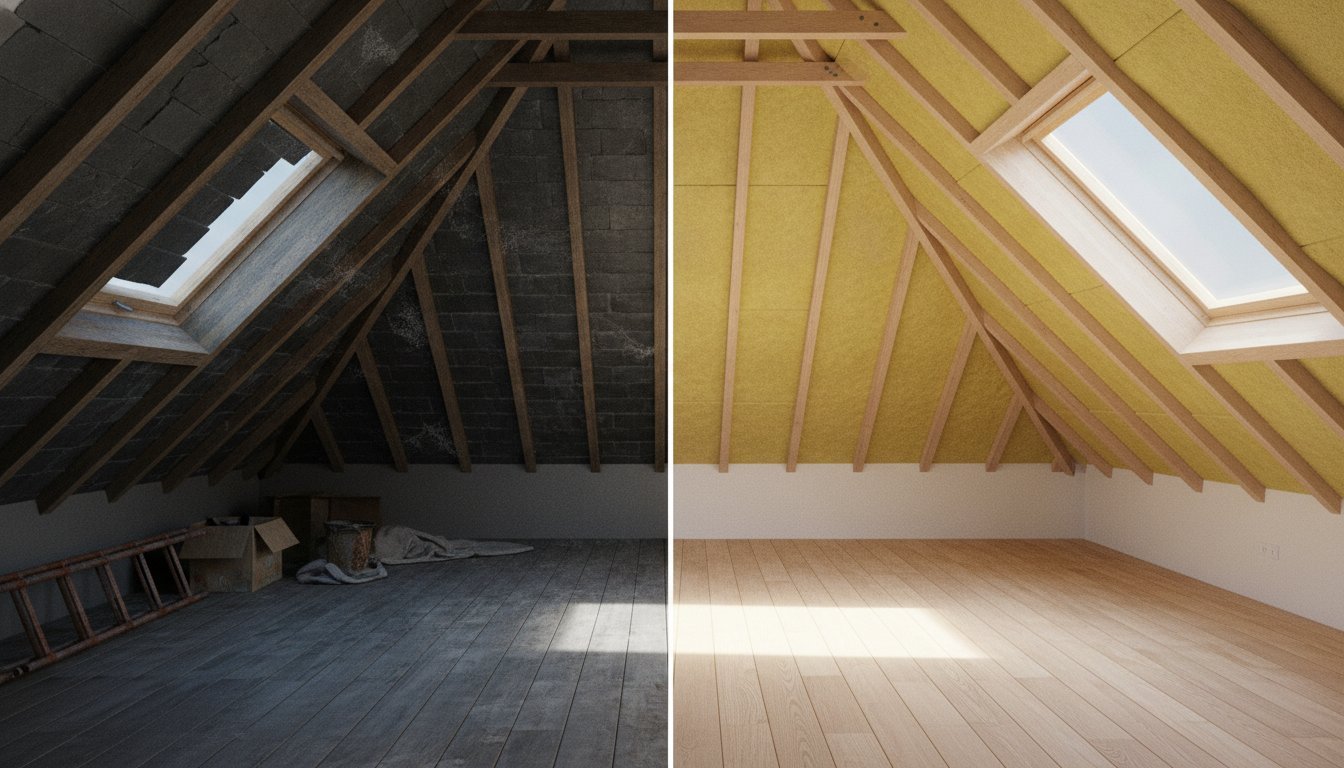
Could your Hackney terrace be losing as much as 25% of its heat through an uninsulated roof? For many homeowners in East London, the struggle against rising energy bills and the recurring threat of condensation in older properties is a constant worry. You likely already know that improving your home’s thermal envelope is the most effective way to secure long-term savings and comfort; however, the technical jargon often makes the first step the hardest.
This guide clarifies the technical differences between insulating a loft floor and the roof rafters, ensuring you make an informed decision for your property’s structural health. We will explore the practical benefits of warm versus cold roof configurations and provide a detailed overview of the factors affecting roof insulation cost Hackney residents should consider in 2026. By the end of this article, you will understand how to maximise your EPC rating and how to potentially access local support, such as the Hackney Green Homes programme, to help transform your living space into a more efficient environment.
Key Takeaways
- Understand the technical distinction between ‘cold roof’ insulation at the joist level and ‘warm roof’ rafter insulation to decide which best suits your home’s layout.
- Identify the specific variables, from material selection to property age, that influence the overall roof insulation cost Hackney residents should budget for in 2026.
- Learn how to preserve the heritage of Victorian and Edwardian terraces by choosing insulation techniques that respect traditional ventilation and slate roof requirements.
- Discover the long-term financial benefits of professional upgrades, including substantial energy bill savings and a higher property value through an improved EPC rating.
- Avoid the common pitfalls of condensation and timber rot by understanding why a professional roof assessment is a prerequisite for a successful insulation project.
Why Hackney Homeowners are Prioritising Loft Insulation in 2026
Rising energy costs throughout 2026 have forced many East London households to re-evaluate their home’s thermal efficiency. In Hackney, where Victorian and Edwardian terraces dominate the streetscape, the challenge is particularly acute. These heritage properties were built to breathe, but without modern intervention, they often leak heat at an unsustainable rate. Understanding the roof insulation cost Hackney homeowners might face is now a priority for those looking to protect their bank accounts and their comfort. Beyond immediate savings, the London market now places a significant premium on properties with high thermal performance. A well-insulated home isn’t just cheaper to run; it’s a more attractive asset for future buyers who are wary of inefficient older builds.
While focusing on the efficiency of a London home is a wise move for local residents, those looking to broaden their investment portfolio might also discover Chainex Real Estate and the potential of the Dubai property market as a high-growth alternative.
For many, beginning a comprehensive thermal roof insulation upgrade starts with the loft floor. It’s a logical first step that provides an immediate barrier against heat loss. When calculating the potential roof insulation cost Hackney properties require, it’s vital to consider the long-term return on investment. Modern standards now recommend a depth of 270mm for mineral wool insulation to achieve optimal results. By addressing this area, you’re not just installing a product; you’re future-proofing your home against further energy price volatility.
The Energy Efficiency Challenge in East London
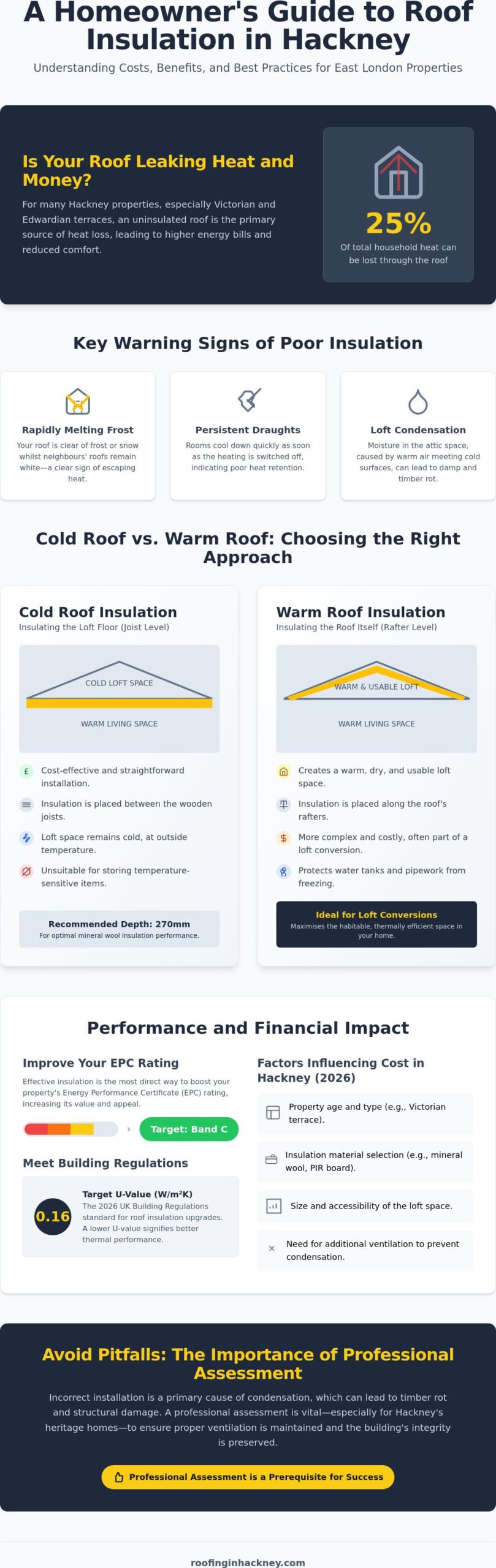
An uninsulated roof can account for approximately 25% of a property’s total heat loss. For Hackney residents, this isn’t just a comfort issue; it’s a financial one. Improving your insulation is the most direct route to raising an Energy Performance Certificate (EPC) rating to the target of Band C. This shift supports the borough’s ‘net zero’ targets whilst making the property significantly more efficient. If you want to improve home energy efficiency through your roof, understanding which materials and methods best suit Hackney’s older housing stock is the essential first step. Selecting the right Building insulation materials is crucial here, as different materials offer varying levels of thermal resistance and breathability, which is essential for Hackney’s older housing stock.
Common Signs Your Hackney Home Needs Better Insulation
You don’t always need a professional survey to know your insulation is failing. During winter, observe your roof after a frost or light snowfall. If your neighbours’ roofs remain white whilst yours is clear, it’s a sign that heat is escaping and melting the frost from beneath. Inside the home, keep an eye out for persistent drafts or rooms that cool down rapidly the moment the heating is turned off. These issues are often linked to attic condensation. When warm air escapes into a cold, uninsulated loft, it hits the internal roof structure and turns into moisture, which can eventually lead to timber rot if left unaddressed.
Loft Insulation vs. Roof Insulation: Comparing the Mechanisms
Deciding between loft and roof insulation requires a clear understanding of how heat and moisture move through your home’s structure. Whilst both methods aim to reduce thermal loss, they achieve this through different placements of the thermal barrier. This choice is a primary driver of the overall roof insulation cost Hackney residents will encounter when planning their project. As of 2026, the UK Building Regulations target a U-value of 0.16 W/m²K for roof insulation upgrades to ensure maximum thermal efficiency and compliance with modern standards.
Cold Roof Insulation: The Traditional Loft Approach
The ‘cold roof’ method involves placing insulation material directly onto the loft floor between the wooden joists. This creates a thermal envelope for the living spaces below, but leaves the loft area itself unheated. Common materials for this approach include mineral wool, sheep’s wool, or cellulose fibre. According to the Energy Saving Trust, this is often the most cost-effective way to improve a home’s thermal performance because the installation process is relatively straightforward.
The main advantage is the immediate reduction in heating bills. However, the trade-off is that your loft will become as cold as the outside air during winter. This makes the space unsuitable for storing temperature-sensitive items or housing water tanks unless they are also specifically insulated. For most Hackney terraces where the attic is used only for light storage, this remains the standard and most practical solution.
Warm Roof Insulation: Converting the Attic into Living Space
A ‘warm roof’ system involves insulating the underside of the roof rafters rather than the floor. This brings the entire attic space inside the ‘warm’ zone of the house. To achieve this, rigid PIR (polyisocyanurate) boards are typically fixed between and over the rafters. Whilst this significantly increases the roof insulation cost Hackney homeowners might pay, it is a necessary investment if you plan to convert the loft into a bedroom or home office in the future. For a full breakdown of how this system works and what it costs, our dedicated guide to warm roof insulation Hackney homeowners can rely on covers every aspect of the installation process and the 0% VAT benefits currently available.
This method requires meticulous attention to detail regarding ventilation. In period properties, a 50mm gap must often be maintained between the insulation and the roof tiles to prevent moisture build-up and timber rot. This approach offers superior moisture control when installed correctly, as it keeps the structural timbers at a consistent temperature. If you are unsure which mechanism is right for your property’s specific pitch and structure, you can speak with our technical team for a professional assessment.
Analysing Roof Insulation Cost in Hackney: Key Financial Factors
Calculating the roof insulation cost Hackney residents can expect involves a combination of material choice, property layout, and the logistical realities of East London. Whilst national averages provide a baseline, Hackney’s unique architectural heritage often requires a more bespoke approach. A standard three-bedroom semi-detached house will naturally require a different investment level than a large Victorian villa or a compact flat. The pitch of your roof also plays a significant role; steeper pitches increase the surface area to be covered and often require more complex safety equipment and longer labour hours.
Project budgets in the capital are also influenced by local London labour rates, which reflect the higher cost of professional expertise and the complexities of operating within congested urban areas. When we provide a quote, we account for the technical proficiency required to handle period structures without compromising their long-term integrity. It’s a standard practice that ensures the craftsmanship matches the investment.
Material Choices and Their Impact on Your Budget
The choice of material is one of the most direct influences on your final bill. Glass mineral wool remains a popular, budget-friendly option that offers reliable performance when installed to the recommended 270mm depth. For those seeking premium thermal solutions, high-performance rigid PIR boards or natural fibres like sheep’s wool offer superior U-values and excellent breathability. According to the Energy Saving Trust guide to roof and loft insulation, selecting a material with high durability ensures your home remains efficient for over 30 years. Natural fibres are particularly well-suited to Hackney’s older brickwork as they help manage moisture levels within the timber structure, providing better long-term value for heritage builds.
Logistics and Accessibility in Hackney Streets
The physical environment of Hackney presents its own set of financial considerations. Narrow residential streets near London Fields or Chatsworth Road often make material delivery a precise operation. Parking restrictions and the need for skip permits can add to the administrative and logistical overhead of a project. These are small but essential details that a local specialist will factor into the initial planning phase. For business owners in these areas, structural care is often paired with aesthetic upgrades; for example, using high-quality printed chalkboard menus from Image Square Printing can help a venue’s visual branding match its newly improved energy efficiency.
If your project involves rafter insulation installed from the exterior, scaffolding will be a necessary requirement to ensure a safe and professional working environment. Additionally, we often find that the removal of old, degraded, or contaminated insulation is a vital first step. This ensures the new system sits flush and performs as intended. If you are concerned about the specific requirements for your terrace, you can contact us for a detailed site assessment that accounts for the roof insulation cost Hackney homeowners must consider for a successful installation.
Selecting the Best Insulation for Hackney’s Period and Modern Homes
Hackney’s architectural landscape is a blend of 19th-century craftsmanship and 21st-century innovation. Each era requires a specific technical approach to ensure thermal efficiency doesn’t come at the cost of structural health. When calculating the roof insulation cost Hackney homeowners must account for, the age and construction type of the building are the most influential variables. For example, the heritage slate roofs found near Victoria Park require a different ventilation strategy than the concrete tiles of a post-war estate. A specialist understands that what works for a modern apartment block will likely cause issues in a Victorian terrace.
Flat roof extensions, a common feature in Hackney’s renovated terraces, present their own set of challenges. Without a properly designed vapour barrier and ventilation gap, these structures are prone to interstitial condensation, which leads to damp and rot. If you are a business owner managing larger premises or industrial units, you may find our commercial roof insulation London guide particularly useful for understanding the scale and requirements of non-residential upgrades. These larger projects often demand different materials and faster installation timelines to minimise business disruption.
Insulating Victorian Terraces: A Specialist Task
Traditional Victorian properties were designed to allow moisture to move through the building fabric. Using non-breathable synthetic materials can trap moisture against original timber rafters, leading to rapid decay. We prioritise breathable insulation materials that work in harmony with lime-mortared brickwork. A common mistake in the borough is over-insulating without considering the “stack effect.” Without adequate eaves and ridge ventilation, a well-insulated loft can become a trap for moist air, eventually compromising the roof’s structural integrity and leading to costly repairs. Homeowners who want to address this challenge effectively should explore the benefits of warm roof insulation Hackney specialists recommend for heritage properties, as it keeps roof timbers at a stable temperature and significantly reduces the risk of interstitial condensation.
Hackney Planning and Conservation Considerations
If your property sits within one of Hackney’s many conservation areas, such as De Beauvoir or South Shoreditch, certain external insulation upgrades may require planning permission. This is especially true if the work alters the roofline or the appearance of heritage slate. Under the 2026 Building Regulations (Part L), any significant renovation of a thermal element must meet strict energy efficiency standards. Working with a specialist who understands Hackney Council’s specific requirements ensures your project remains compliant whilst achieving the best results. This local knowledge is vital for a smooth project flow.
Understanding the roof insulation cost Hackney projects entail means looking beyond the materials and considering these regulatory and structural nuances. To ensure your home is both warm and legally compliant, you should request a professional consultation with our local team.
Ensuring Success: The Importance of Professional Roofing Specialists in Hackney
While the initial roof insulation cost Hackney residents face is a major consideration, the long-term value of the project depends entirely on the precision of the installation. Many homeowners are tempted by DIY solutions or general handymen to save on upfront expenses. However, Hackney’s period properties require a nuanced understanding of building physics that goes beyond simply laying down mineral wool. A professional approach ensures that the thermal barrier is continuous and that the structural integrity of the roof remains uncompromised. To move forward with confidence, you can request a bespoke quote from Roofing in Hackney, where our team provides a comprehensive analysis that balances efficiency with structural safety.
A significant benefit of hiring a specialist is the ability to integrate insulation with other essential maintenance. During a thermal assessment, we often identify minor issues that could become major problems if ignored. This might include deteriorating leadwork around a chimney stack or cracked slates that are allowing water ingress. By addressing these repairs alongside your insulation upgrade, you ensure a watertight and thermally efficient finish that protects your investment for decades.
The Risks of Incorrect Insulation Installation
Incorrectly installed insulation often creates ‘cold bridges’. These are small gaps in the thermal layer where heat escapes rapidly, causing localised cold spots on internal ceilings. When warm, moist air from a London kitchen or bathroom hits these spots, it condenses, leading to persistent mould growth that is difficult to eradicate. Even more critical is the danger of blocking eaves ventilation or soffit vents. A specialist roofer understands that a roof must breathe; blocking these airflow paths traps moisture in the attic, which can rot the very rafters supporting your home. This is why a professional roofer is always better suited to this task than a generalist who may not appreciate the delicate balance of attic ventilation.
Next Steps for Your Hackney Roofing Project
The first step in any successful upgrade is a professional thermal survey of your roof space. This assessment identifies exactly where heat is escaping and determines whether your current roof structure is suitable for the proposed insulation method. Preparing your home for this work is straightforward, but it usually involves clearing the attic space to allow for a thorough inspection of the timbers and joists. If the survey reveals that your timbers are already significantly damaged by damp or woodworm, you may need to consider a professional roof replacement Hackney homeowners can trust to provide a secure foundation for new insulation. Our methodical process ensures you are informed at every stage, from the initial site visit to the final quality check.
Securing Your Hackney Home’s Thermal Future
Upgrading your insulation is a definitive step towards a more efficient and comfortable home. The decision to insulate the loft floor or the rafters depends on your property’s specific requirements and your future plans for the attic space. In Hackney’s Victorian and Edwardian terraces, this investment isn’t merely about the immediate roof insulation cost Hackney residents encounter; it’s a vital measure to protect the building’s fabric from condensation whilst significantly reducing heat loss. For a comprehensive overview of every strategy available to you, our dedicated guide on how to improve home energy efficiency through your roof covers the full range of thermal upgrades suited to East London properties.
At Roofing in Hackney, we combine traditional craftsmanship with modern thermal standards. Our expertise as specialist roofing and leadwork contractors ensures that every insulation upgrade prioritises both structural safety and long-term energy performance. We understand the unique challenges of East London’s heritage housing stock and are committed to delivering results that stand the test of time. Don’t leave your home’s efficiency to chance when expert guidance is readily available.
Request a Professional Insulation Survey from Roofing in Hackney today to begin your journey toward a warmer, more efficient home. Taking this step now will ensure your property remains a valuable and comfortable asset for years to come.
Frequently Asked Questions
How much does loft insulation cost in Hackney for a 3-bedroom terrace?
The final roof insulation cost Hackney homeowners pay depends on several logistical factors, including the choice of material and the ease of access to the roof space. For a typical Victorian terrace, we must also consider whether existing, degraded insulation requires professional removal before the new system is installed. A bespoke survey is the only way to ensure the quote reflects the specific requirements of your property’s joist spacing and roof pitch.
Is loft insulation or roof insulation better for saving money on bills?
Loft insulation is typically the more cost-effective option for reducing energy bills if you don’t intend to use the attic as a living space. By insulating the floor between the joists, you create a thermal barrier that keeps heat within your living quarters. Roof insulation is a larger investment but is necessary if you want the attic to remain at a comfortable, controlled temperature throughout the year.
Can I install loft insulation myself in a Victorian house?
We don’t recommend DIY installation for heritage properties. Victorian houses were built to breathe, and an amateur installation often blocks essential ventilation paths at the eaves. This leads to moisture build-up and timber rot. A professional roofer ensures that the insulation is effective whilst maintaining the airflow required to protect your home’s structural integrity.
What is the recommended thickness for loft insulation in the UK in 2026?
Current building regulations recommend a total depth of 270mm for mineral wool insulation. If your property currently has 100mm or less, you may be eligible for a top-up to meet modern standards. Achieving this depth is crucial for reaching an EPC rating of Band C and maximising your annual energy savings.
Does roof insulation cause damp or mould in older Hackney properties?
Damp only occurs if insulation is installed without proper regard for ventilation. In older slate roofs, we maintain a 50mm gap between the insulation material and the roof tiles to allow air to circulate. This prevents the interstitial condensation that causes mould. Professional installation ensures your roof insulation cost Hackney project results in a dry, healthy environment rather than a moisture trap.
How long does it take to install loft insulation in a typical Hackney flat?
A standard installation usually takes between four to eight hours. The duration varies based on the volume of material required and whether we need to clear the space of old debris first. Most projects are completed within a single working day, causing minimal disruption to your daily routine.
Are there any grants available for loft insulation in Hackney in 2026?
Several schemes are active, including the Hackney Green Homes Programme and the Great British Insulation Scheme (GBIS), both of which accept applications until March 2026. These grants target properties with low EPC ratings and can provide significant financial support. Eligibility often depends on your household income and Council Tax band, so it’s wise to check the latest council guidelines.
Will insulating my roof rafter allow me to use the loft as a bedroom?
Rafter insulation is the first step, as it brings the attic into the warm zone of the house. However, a legal bedroom conversion requires more than just thermal upgrades. You’ll also need to ensure the project complies with building regulations regarding structural floor strength, fire safety exits, and adequate head height before the space can be officially classed as a habitable room.