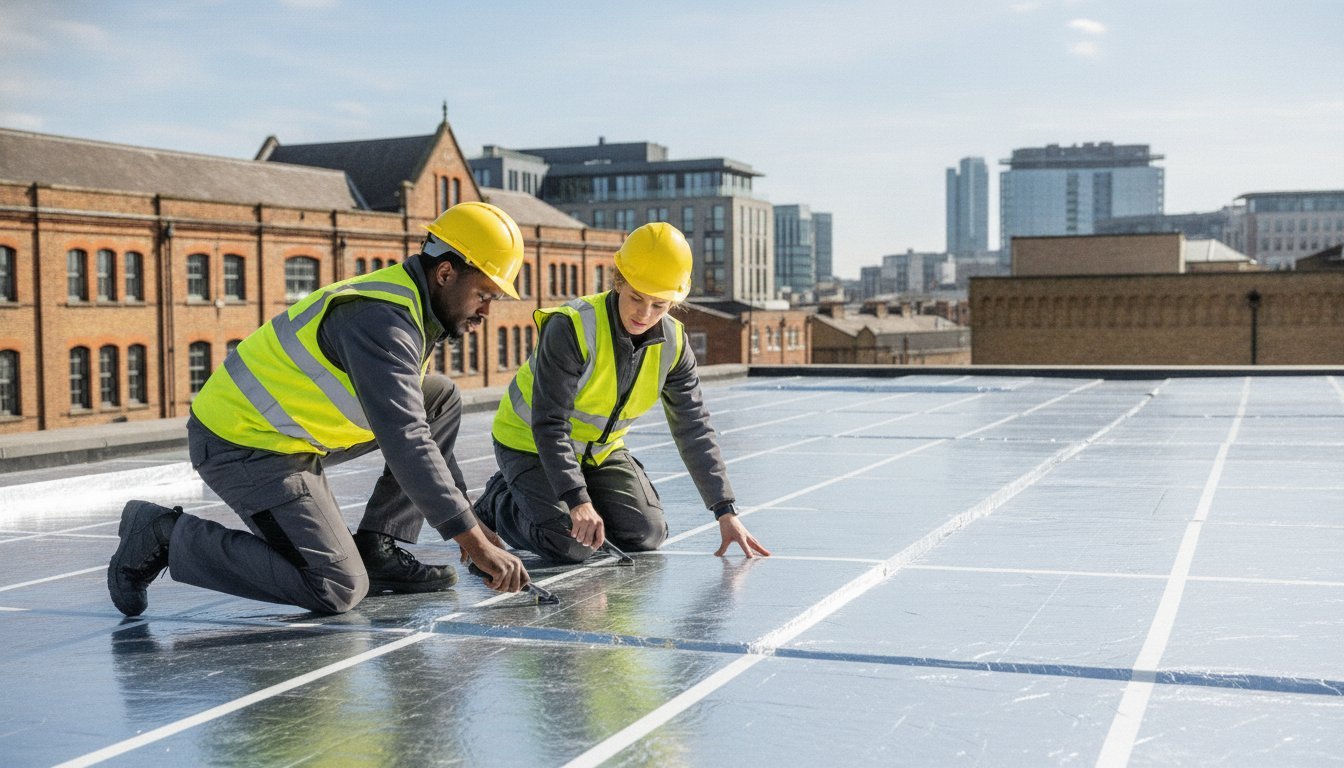
Did you know that an uninsulated roof can account for approximately 25% of the total heat loss in a typical commercial building? In a city where overheads are already high, this represents a significant and unnecessary drain on your company’s annual profits. Prioritising commercial roof insulation London is a practical step that transforms your building from a thermal liability into a high-performing, energy-efficient asset.
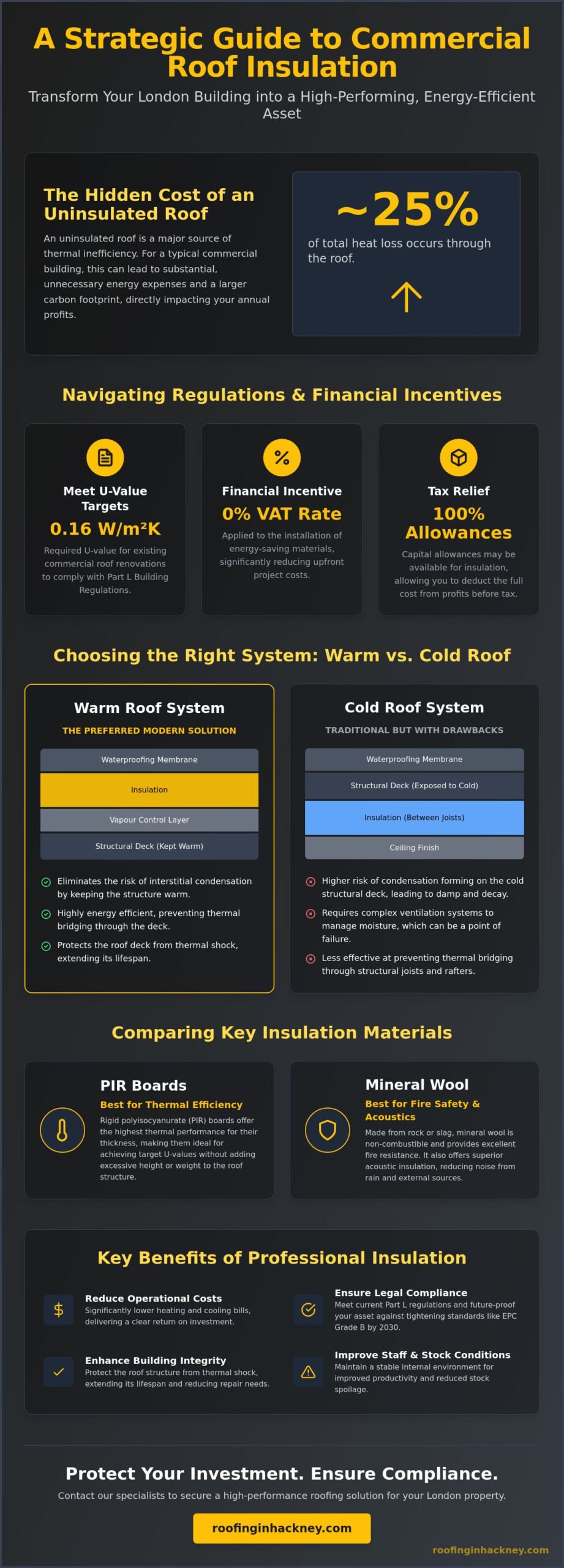
We understand that navigating the latest thermal standards can feel overwhelming, particularly with the current “consequential improvements” rule requiring full compliance if you refurbish more than half of your roof’s surface area. You need a solution that balances strict regulatory demands with the need for minimal business disruption. This guide explains how to achieve superior thermal performance whilst securing your building’s future and meeting the 0.16 W/m²K U-value targets required for existing commercial renovations.
We will break down the financial incentives currently available, including the 0% VAT rate on energy-saving materials and 100% capital allowances. You’ll also learn about the methodical installation processes used to extend your roof’s lifespan and lower your utility bills without interrupting your daily operations.
Key Takeaways
- Recognise how strategic insulation upgrades act as a high-performance barrier to significantly reduce operational costs and heat loss.
- Identify whether a warm roof or cold roof system is the most appropriate choice for your property’s specific structural requirements.
- Evaluate the benefits of industry-standard materials, such as PIR boards for thermal efficiency or mineral wool for enhanced fire safety.
- Understand the legal implications of Part L Building Regulations and how the “50% rule” affects your plans for commercial roof insulation London.
- Gain insights into professional installation techniques that protect your building envelope whilst ensuring long-term durability and compliance.
The Strategic Importance of Commercial Roof Insulation in London
Commercial roof insulation London serves as a high-performance barrier specifically engineered to minimise thermal transfer across large-scale building envelopes. By managing the flow of heat, these systems ensure that internal temperatures remain stable regardless of external conditions. This is based on fundamental building insulation principles that prioritise the reduction of conductive and convective heat loss through the roof structure.
For London-based businesses, this isn’t just a matter of comfort; it’s a strategic necessity. With utility tariffs in the capital remaining volatile, uninsulated roofs act as a constant drain on financial resources. Additionally, landlords face tightening legal requirements regarding energy performance. Current government trajectories suggest that all commercial rented properties must achieve an EPC Grade B rating by 2030. Upgrading your roof’s thermal performance is often the most impactful way to bridge the gap between a failing grade and legal compliance.
Beyond energy savings, high-quality insulation protects the building’s physical integrity. London’s climate can be highly variable, leading to significant thermal expansion and contraction in roof structures. This ‘thermal shock’ can cause cracks in membranes and structural decay over time. A robust insulation layer stabilises the temperature of the structural deck, which significantly extends the lifespan of the entire roofing system and reduces the need for frequent repairs.
Reducing Operational Overheads in London Commercial Hubs
Large commercial spaces, particularly warehouses and retail units with expansive flat roofs, are prone to extreme heat loss. During winter months, heat rises and escapes through thin or degraded materials. Investing in an upgrade provides a clear ‘payback period’ as reduced heating and cooling requirements often offset the initial installation costs within a few years. A well-regulated environment also improves staff productivity, a goal shared by health-focused organisations like the Houston Medical Wellness Clinic, and prevents stock spoilage caused by unexpected temperature fluctuations.
Environmental Compliance and the London Plan
The London Plan outlines a specific energy hierarchy, starting with the ‘Be Lean’ stage. This stage demands that building owners prioritise fabric efficiency before considering renewable technologies. By enhancing your commercial roof insulation London, you directly reduce your building’s carbon footprint and demonstrate a commitment to sustainability. This proactive approach future-proofs your asset against tightening UK environmental legislation, ensuring your property remains attractive to high-calibre tenants who increasingly value green credentials.
Decoding Thermal Performance: Warm Roof vs Cold Roof Systems
Selecting the correct configuration for commercial roof insulation London is a technical decision that dictates how your building manages heat and moisture for decades. The fundamental choice revolves around where the insulation layer sits within the roof assembly. This placement determines whether your structural deck remains inside or outside the building’s thermal envelope. It’s a choice that impacts everything from energy efficiency to long-term structural health.
In a warm roof system, the insulation is installed above the structural deck. This ensures the deck stays at a temperature close to the building’s interior. Conversely, a cold roof system places the insulation between the rafters or joists. This leaves the structural deck exposed to external temperature fluctuations. Commercial structures often have complex steel or concrete frames that are prone to thermal bridging. This occurs when heat escapes through highly conductive structural members, creating “cold spots” where moisture can collect. Addressing these bridges is a core requirement of UK Building Regulations Part L, which mandates strict control over heat loss at junctions and openings.
The Advantages of Warm Roof Upgrades for London Businesses
Warm roof systems are generally the preferred choice for modern commercial flat roof replacements. By keeping the structural deck above the dew point, you effectively eliminate the risk of interstitial condensation within the roof’s core. These systems are also easier to install during a full refurbishment because the insulation layers are laid continuously over the deck. This creates a seamless thermal barrier that protects the vapour control layer from mechanical damage and extreme temperature shifts, ensuring the roof remains airtight and efficient.
When to Consider Cold Roof Insulation
Whilst warm roofs are often ideal, cold roof configurations are sometimes necessary for period commercial buildings in Hackney and East London. These properties often have established rooflines or attic-style office conversions where increasing the external roof height isn’t feasible due to planning constraints. However, cold roofs require meticulous planning. You must maintain a 50mm clear air gap above the insulation to allow for cross-ventilation. Without this airflow, timber rot and damp can quickly compromise the structure. If you’re managing a heritage property and need to understand your options, you can speak with our specialist team to determine the safest approach for your building.
Comparing Commercial Insulation Materials for London Buildings
Choosing the correct material for commercial roof insulation London involves a technical evaluation of thermal conductivity, fire ratings, and acoustic performance. Every property has unique requirements, so a one-size-fits-all approach rarely yields the best results. We rely on rigorous data from the Building Research Establishment to ensure that the materials we select meet the high standards required for urban building envelopes. The goal is to achieve the mandatory 0.16 W/m²K U-value for renovations whilst ensuring the structure remains safe and durable.
PIR Boards: Maximising Efficiency in Tight Spaces
Polyisocyanurate (PIR) rigid foam boards are the industry standard for London flat roofs. Their primary advantage is high thermal resistance coupled with a very thin profile. In a city where height restrictions often limit how much you can raise a roofline, PIR boards allow you to meet modern building regulations without altering the building’s external appearance. These boards are incredibly durable; they don’t sag or lose their thermal properties over their 30-year lifespan. They’re a reliable choice for businesses that prioritising long-term energy savings and minimal structural weight.
Mineral Wool: Safety and Soundproofing for Urban Environments
Mineral wool, often referred to as stone wool, is a non-combustible material that provides an extra layer of fire protection. This is a critical factor for high-density London zones and multi-tenanted office blocks where safety regulations are exceptionally strict. Beyond its fire-retardant properties, mineral wool offers superior acoustic insulation. It effectively dampens the constant hum of city noise, such as sirens and heavy traffic, creating a much calmer working environment inside. It’s often manufactured from recycled materials, which helps your business align with modern sustainability goals.
For industrial units and warehouses, other options like Spray Polyurethane Foam (SPF) or composite panels might be appropriate. Closed-cell SPF can act as a secondary water barrier, whilst composite panels offer an integrated solution for rapid installation on vast roof areas. However, these require careful assessment to ensure they don’t trap moisture against the structural deck. Whether you’re upgrading a retail unit or a large warehouse, selecting the right material is the first step toward a more cost-effective and compliant building. For a comprehensive overview of current material standards and depth recommendations, our thermal roof insulation upgrades guide for 2026 provides detailed guidance on achieving optimal U-values across Hackney’s diverse property types.
Navigating Regulations and Project Planning for London Commercial Hubs
Every significant refurbishment in the capital is governed by Part L of the Building Regulations. One of the most critical triggers for a thermal upgrade is the “50% rule.” If you’re repairing or replacing more than half of your roof’s surface area, the entire structure must be brought up to current thermal standards. This regulatory requirement ensures that commercial roof insulation London isn’t just an optional extra but a mandatory component of large-scale maintenance. Failing to account for this can lead to significant delays and complications with Building Control late in the project.
Before any materials are laid, a structural survey is essential. Modern high-density insulation boards, whilst efficient, can add weight that older structural decks weren’t originally designed to carry. We conduct a thorough assessment of the existing roof deck to ensure it can support the new thermal layers without compromising the building’s integrity. This grounded, expert-led approach provides the security you need when making a major structural investment.
Part L Compliance and U-Value Targets
For existing commercial building renovations in 2026, the current target U-value is 0.16 W/m²K. Building Control officers will require detailed technical data sheets and evidence of correct installation before they issue a final certificate of completion. This documentation is vital for your property’s legal standing and its future marketability. Properties with high thermal performance ratings command significantly higher market value and lower yields during lease renewals due to their reduced operational costs and improved EPC ratings. Property owners who also want to understand the roof insulation cost Hackney residents face in 2026, including the differences between loft and roof insulation approaches, will find a detailed breakdown of budgeting factors and efficiency considerations in our dedicated guide.
Strategic Project Management for London Landlords
Managing a project in high-density areas like Hackney requires a methodical approach to health and safety and logistics. We often implement phased installations to ensure that businesses remain fully operational below whilst work continues on the roof. This involves dividing the roof into specific zones, which allows us to maintain a watertight seal at the end of each shift and minimises disruption to your tenants. You can learn more about our expert approach to complex urban projects and how we navigate the unique challenges of London’s commercial landscape.
If you’re planning a refurbishment and need to ensure your project meets all current legal requirements whilst maintaining business continuity, contact our specialist team for a professional consultation and a clear, organised workflow for your commercial roof insulation London project.
Expert Implementation: High-Performance Roofing Solutions in Hackney
Hackney’s commercial landscape is exceptionally diverse. From converted Victorian warehouses in Shoreditch to sleek new developments near the Olympic Park, each building presents unique structural challenges. Successfully implementing commercial roof insulation London requires a deep understanding of these local architectural nuances. A standard approach won’t work when you’re dealing with the varied thermal behaviours of aged brickwork versus modern steel frames. Local expertise ensures that the chosen insulation system respects the building’s history whilst providing modern efficiency.
Our process focuses on seamless integration across all roofing types. If your property features a traditional slate roof, the insulation must be installed to preserve the character whilst meeting strict U-value targets. For flat roofs, we utilise high-performance membranes that bond perfectly with the underlying insulation layer. This precision prevents water ingress and ensures the thermal barrier remains unbroken across the entire roof surface. It’s this level of detail that separates a temporary fix from a long-term structural upgrade.
Professional craftsmanship is the only way to secure genuine value for your investment. Quick-fix solutions often overlook critical details like airtightness at junctions, leading to heat leaks and premature material failure. We take pride in a methodical workflow that moves from an initial thermal survey through to final commissioning. This ensures every component meets the rigorous standards of 2026 building regulations and provides the peace of mind that your building is protected for the long term.
Bespoke Insulation Strategies for East London Businesses
We tailor every strategy to the specific use of the building. A cold storage facility has vastly different thermal requirements than a heated office suite or a retail showroom. Our team evaluates these needs to recommend the most efficient material thickness and type for your specific operation. Often, we combine insulation work with essential maintenance like leadwork and chimney repairs to provide a comprehensive shield for your property. For those considering larger structural projects, we recommend reading our Professional Roof Replacement in Hackney guide for a deeper look at full-scale renovations.
Securing Your Investment with Roofing in Hackney
Investing in your building’s envelope is a commitment to its future. We use only premium materials that are designed to exceed current energy standards, providing a level of durability that protects your capital for decades. A seamless finish is our hallmark; it’s the only way to truly prevent thermal bridging and the structural damp that often follows poor installations. If you’re ready to optimise your property’s performance and reduce your carbon footprint, Contact Us today to arrange a professional thermal survey of your commercial premises and take the first step toward a more efficient future.
Future-Proofing Your Commercial Asset Through Strategic Upgrades
Upgrading your property’s thermal performance is a decisive step toward long-term financial stability and regulatory compliance. By selecting the correct system configuration and high-performance materials, you don’t just lower your utility bills; you secure the structural integrity of your building for decades. Whether you’re navigating the complexities of heritage structures or optimising a modern warehouse, the right approach to commercial roof insulation London ensures your asset remains competitive in an increasingly demanding market.
As specialists in Hackney commercial roofing, we provide expert guidance that’s fully compliant with 2026 Part L Building Regulations. Our team offers extensive expertise in both modern flat roofs and sensitive heritage structures, ensuring every project is handled with precision and care. Property owners across the borough looking to understand the full scope of current standards and available options will find our dedicated thermal roof insulation upgrades buying guide for Hackney an essential resource before committing to any works. To take the next step in optimising your building’s efficiency, Book a Professional Thermal Survey for Your London Commercial Property. We look forward to helping you transform your property into a high-performing, sustainable environment.
Frequently Asked Questions
How much will commercial roof insulation reduce my energy bills in London?
Uninsulated roofs account for approximately 25% of heat loss in typical commercial buildings. By installing high-performance insulation, you can significantly reduce this waste, leading to a noticeable drop in annual heating and cooling expenses. The exact saving varies based on your building’s current efficiency and usage patterns, but most London businesses see a return on investment through lower utility tariffs within a few years of installation.
Does my commercial roof upgrade need to comply with Part L Building Regulations?
Yes, any significant renovation to a commercial building envelope must comply with Part L of the Building Regulations. This is specifically triggered if you refurbish more than 50% of the roof’s surface area. In such cases, the entire roof must be upgraded to meet current thermal standards, which currently target a U-value of 0.16 W/m²K for existing commercial properties undergoing major renovation works.
Can I install new insulation on top of my existing commercial roof?
It’s often possible to install new insulation over an existing deck, a process known as an overlay or warm roof system. However, this is subject to a structural survey to ensure the building can support the additional weight of modern high-density boards. We also check that the existing roof is free from moisture, as trapping damp between layers can lead to long-term structural decay and material failure.
What is the best insulation material for a London warehouse roof?
PIR boards are often the most effective choice for a London warehouse because they offer high thermal resistance with a thin profile. For very large-scale industrial units, composite panels are also popular as they combine the outer skin and insulation into one unit for rapid installation. Both options help achieve the necessary U-values whilst keeping the structural load manageable for large-span roof structures.
How long does a commercial roof insulation project typically take?
A typical project for commercial roof insulation London can take anywhere from one to three weeks depending on the building’s size and the system’s complexity. We use phased installation strategies to ensure your business remains operational throughout the works. A clear timeline is always established during the planning phase to minimise disruption to your staff, stock, or daily commercial activities in busy urban areas.
Will an insulation upgrade help my building achieve a better EPC rating?
An insulation upgrade is one of the most effective ways to improve a building’s EPC rating. Since the government intends for all commercial rented properties to achieve a Grade B by 2030, a fabric-first approach is essential. Improving the roof’s thermal performance reduces the building’s overall carbon footprint, making it more attractive to high-calibre tenants and increasing the property’s total market value during lease renewals.
Is spray foam insulation safe for commercial properties in high-density areas?
Spray foam can be used, but it must be carefully specified for high-density urban environments. Closed-cell foam provides excellent airtightness, yet fire safety is a paramount concern in London. In many cases, we recommend non-combustible mineral wool as a safer alternative for multi-tenanted buildings or properties in close proximity to others. This ensures your property meets strict safety standards whilst providing superior acoustic dampening.
What happens if I don’t upgrade my roof insulation during a major repair?
If you ignore insulation requirements during a major repair, you risk legal non-compliance and potential issues with Building Control. Beyond the legalities, your property will continue to suffer from high energy bills and thermal shock, where temperature fluctuations cause the roof structure to expand and contract. This leads to premature degradation, leaks, and a significantly shorter lifespan for your recent roofing repairs and structural investments.