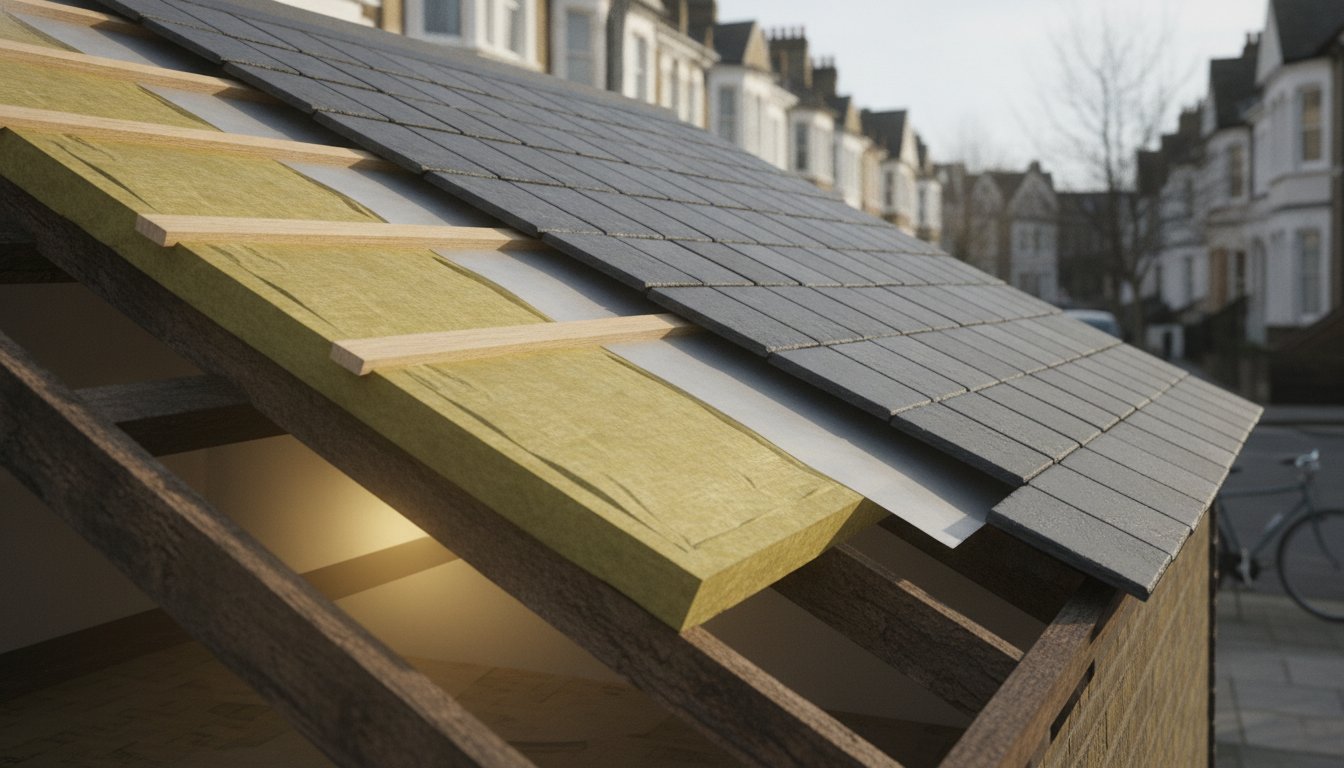
Did you know that an uninsulated roof can be responsible for up to 25% of your home’s total heat loss? For owners of heritage properties across the borough, this isn’t just a statistic; it’s the underlying cause of draughty rooms and climbing energy bills. You’ve likely found that traditional loft insulation often results in a loss of storage space and fails to address the condensation that plagues older buildings. By opting for warm roof insulation Hackney homeowners can shift the thermal barrier to the exterior of the rafters, keeping the roof timbers warm and the living space protected from damp.
We recognise that maintaining a Victorian or Edwardian home requires a balance of traditional craftsmanship and modern efficiency. This guide will explain how a warm roof system transforms your property’s performance, helping you meet the latest 0.16 W/m²K U-value standards whilst taking advantage of the 0% VAT rate on insulation products available until March 2027. We will outline the structural benefits of this fabric-first approach, the potential for significant energy savings, and the methodical process required to secure your home’s future comfort and structural integrity.
Key Takeaways
- Learn how the “sealed envelope” approach places insulation above the rafters to protect your property’s structural integrity and maximise internal space.
- Discover why warm roof insulation Hackney is the most effective solution for meeting modern thermal standards whilst permanently eliminating internal condensation.
- Identify the technical materials, including PIR rigid foam boards and Vapour Control Layers, required to achieve superior U-values in heritage buildings.
- Understand the professional installation sequence and how to navigate local Building Regulations and logistical challenges on busy Hackney streets.
- Evaluate the long-term return on investment provided by a specialist thermal upgrade, ensuring your home remains energy-efficient and damp-free for decades.
What is Warm Roof Insulation and Why Does Hackney Need It?
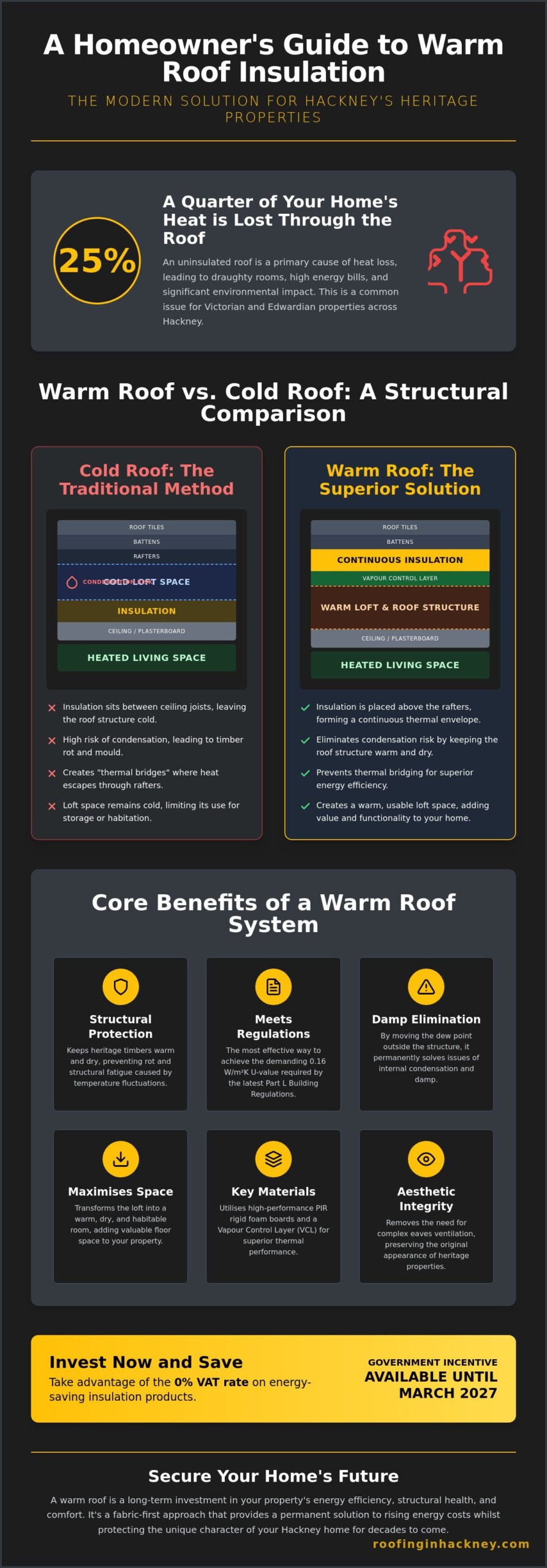
A warm roof system represents a fundamental shift in how we protect our homes from the elements. Unlike traditional Hackney loft insulation, which usually sits between the ceiling joists, warm roof insulation Hackney involves installing a continuous layer of insulation above the rafters. This method effectively brings the roof structure into the warm part of the house, creating a sealed thermal envelope. To grasp the science behind this, one must consider What is thermal insulation? and how it functions as a barrier to heat transfer. By placing this barrier on the outside of the timber frame, we eliminate the cold bridges that often lead to heat loss and structural decay.
Hackney properties face unique environmental pressures. Our East London climate is characterised by damp, biting winters and the increasing impact of the urban heat island effect during summer. In uninsulated Victorian terraces, heat escapes rapidly through the roof, forcing boilers to work harder and driving up fuel costs. A warm roof doesn’t just keep the heat in during January; it also reflects solar gain in July, ensuring the upper floors remain comfortable year round. This dual benefit is particularly vital in densely populated urban areas where temperature fluctuations can be extreme.
The Structural Advantages for Hackney Properties
This approach offers significant protection for the heritage timbers found in older buildings. By keeping the rafters at a consistent internal temperature, we prevent the constant expansion and contraction that leads to structural fatigue. Because the insulation is external to the frame, the dew point is moved outside the timber, which stops moisture from condensing and causing rot. This setup also removes the need for complex eaves ventilation, which is often difficult to install correctly in narrow Hackney streets or conservation areas without compromising the building’s aesthetic. The result is a usable, breathable loft space that feels like a natural extension of the home rather than a cold attic.
Tackling the Hackney Energy Crisis in 2026
With the borough working toward ambitious Net Zero targets, thermal upgrades have become a priority for responsible homeowners. As we move through 2026, the focus has shifted toward a fabric-first approach to sustainability. Implementing a warm roof is an essential part of how to improve home energy efficiency roof performance, which directly correlates with increased property value. Whilst some residents may be eligible for local energy grants, the complexity of these structural changes requires the precision of a specialist contractor to ensure compliance with the latest Part L Building Regulations. Investing in these upgrades now provides a permanent solution to rising energy costs whilst securing the building’s future.
Warm Roof vs. Cold Roof: Which is Best for Your Property?
Deciding between a warm or cold roof system often depends on how you intend to use your loft and the structural health of your building. In Hackney’s Victorian terraces, a cold roof is the traditional setup, where insulation is placed between the ceiling joists. This leaves the rafters and the loft space exposed to the cold. Conversely, warm roof insulation Hackney involves installing the thermal barrier above the rafters, keeping the entire roof structure within the building’s heated envelope. This distinction is vital for those looking to maximise their home’s thermal efficiency.
One of the most critical factors for Hackney homeowners is the “dew point,” which is the temperature where moisture in the air condenses into liquid. In a cold roof, this point often occurs on the underside of the roof deck or within the loft itself. Without perfect ventilation, this leads to damp, timber rot, and mould. By moving the dew point to the outside of the rafters, a warm roof system ensures that your structural timbers remain dry and stable, which is essential for the longevity of heritage properties.
From a performance perspective, warm roofs are generally superior. They provide a continuous layer of insulation that eliminates thermal bridging, where heat escapes through the timber rafters. This makes it much easier to achieve the 0.16 W/m²K U-value target required when upgrading thermal elements in existing homes. Whilst the initial investment for a warm roof is higher due to the structural work involved, the long-term savings on energy bills and the prevention of damp related repairs often justify the cost.
When to Choose a Cold Roof System
A cold roof might be the practical choice if your loft is strictly for storage and you’re working with a tighter budget. It’s a simpler installation that doesn’t require removing the existing roof covering. However, you must ensure that the eaves are properly ventilated to avoid moisture buildup. You can find a detailed breakdown of the costs and benefits in our guide to loft insulation vs roof insulation.
Why Warm Roofs Win for Flat Roof Extensions
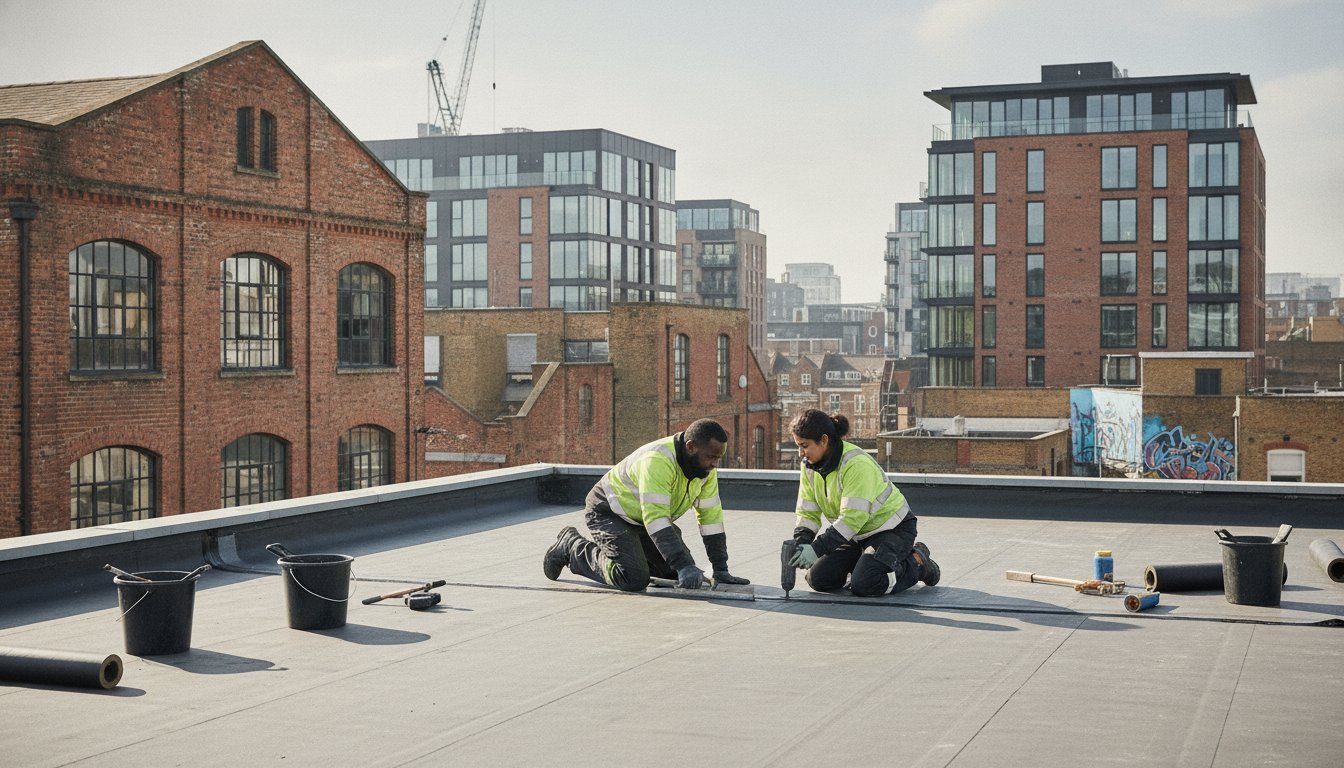
For a modern flat roof installation Hackney project, the warm roof is almost always the preferred specification. It prevents interstitial condensation, a common problem where moisture gets trapped between the layers of a flat roof deck. This design is crucial for meeting 2026 Building Regulations for new extensions, ensuring the roof remains breathable and structurally sound for decades. If you aren’t sure which system is right for your home, our technical team can provide a property assessment to help you decide.
Technical Material Choices for Hackney Warm Roofs
Selecting the correct materials is the cornerstone of a successful thermal upgrade. In the context of warm roof insulation Hackney specialists almost exclusively recommend Polyisocyanurate (PIR) rigid foam boards. These boards offer the highest thermal performance for their thickness, which is a vital consideration for the compact urban lofts found across East London. When we strip back a roof to install a warm system, we aren’t just adding bulk; we’re engineering a layered defence against heat loss and moisture. This requires a precise combination of PIR boards, a Vapour Control Layer (VCL), and high-performance breathable membranes that work in harmony with traditional materials like slate and lead.
PIR Boards vs. Mineral Wool
In many Hackney properties, internal head height is at a premium. Whilst mineral wool is a common choice for cold roofs, it requires a significantly thicker layer to achieve the same thermal resistance as PIR. PIR boards typically have a lambda value of approximately 0.022 W/mK, making them nearly twice as efficient as standard mineral wool per centimetre. This efficiency allows us to meet the mandatory 0.16 W/m²K U-value target without creating an excessively high roof profile. Modern PIR boards also come with improved fire ratings and are manufactured with zero ozone depletion potential, aligning with the sustainability goals of the borough’s 2026 climate initiatives. Their rigid nature also ensures they won’t sag or degrade over time, maintaining their thermal properties for the life of the roof.
Vapour Control and Breathability
A common concern with modernising Victorian terraces is the risk of making the building “too airtight,” which can trap moisture within the structure. To prevent this, we install a Vapour Control Layer (VCL) on the warm side of the insulation. A Vapour Control Layer is the primary barrier that prevents internal moisture migration from the living space into the roof structure. Above the PIR boards, we use a high-performance breathable membrane. This allows any residual moisture to escape whilst providing a secondary line of defence against wind-driven rain. This layered approach is particularly important when integrating with heritage slate or tile, where traditional leadwork details at the chimney and eaves must remain functional and watertight. To secure these layers against East London wind loads, we use specialist helical fixings that penetrate the insulation and anchor directly into the rafters, ensuring the entire assembly is structurally sound and secure.
The Installation Process and Building Regulations in Hackney
Implementing a warm roof system is a significant structural undertaking that demands more than a simple material swap. When we install warm roof insulation Hackney homeowners should expect a methodical, multi-stage project that addresses the building’s thermal performance and its structural health simultaneously. Because this process involves raising the roof’s profile by several centimetres, it requires precise coordination with existing features like chimneys and parapet walls. It’s a task that moves beyond simple DIY and into the realm of professional structural engineering.
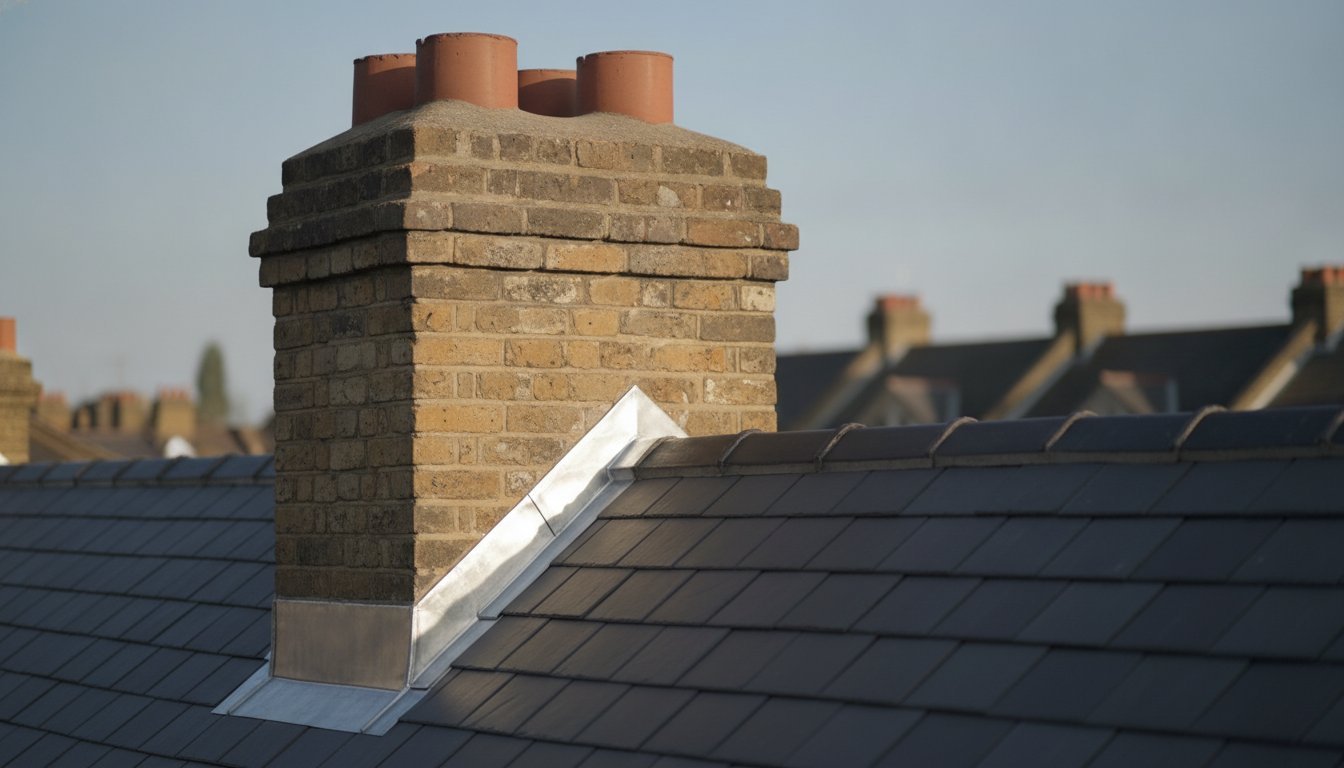
Logistics in East London present their own unique challenges. We manage the entire scaffolding process, ensuring all necessary permits are secured for narrow pavements and busy residential streets. Safety is our absolute priority; we maintain a clean and secure site to minimise disruption to your neighbours and the public. During the insulation phase, we also take the opportunity to address essential maintenance such as chimney repointing and leadwork repairs. This ensures that the new thermal layers are perfectly integrated with the building’s masonry, preventing water ingress at the most vulnerable junctions.
Compliance with Hackney Building Control
Under Part L of the Building Regulations, any renovation that involves replacing more than 25% of a roof’s surface area must be notified to the local authority. We ensure your upgrade meets the mandatory 0.16 W/m²K U-value target required for existing dwellings as of July 2026. This is particularly sensitive in Hackney’s many Conservation Areas, such as De Beauvoir or Victoria Park, where the external appearance must remain unchanged despite the increased roof height. We provide the necessary U-value calculations and technical documentation to secure your completion certificate, which is a vital legal document for any future property sale or insurance claim.
Step-by-Step: A Typical Hackney Installation
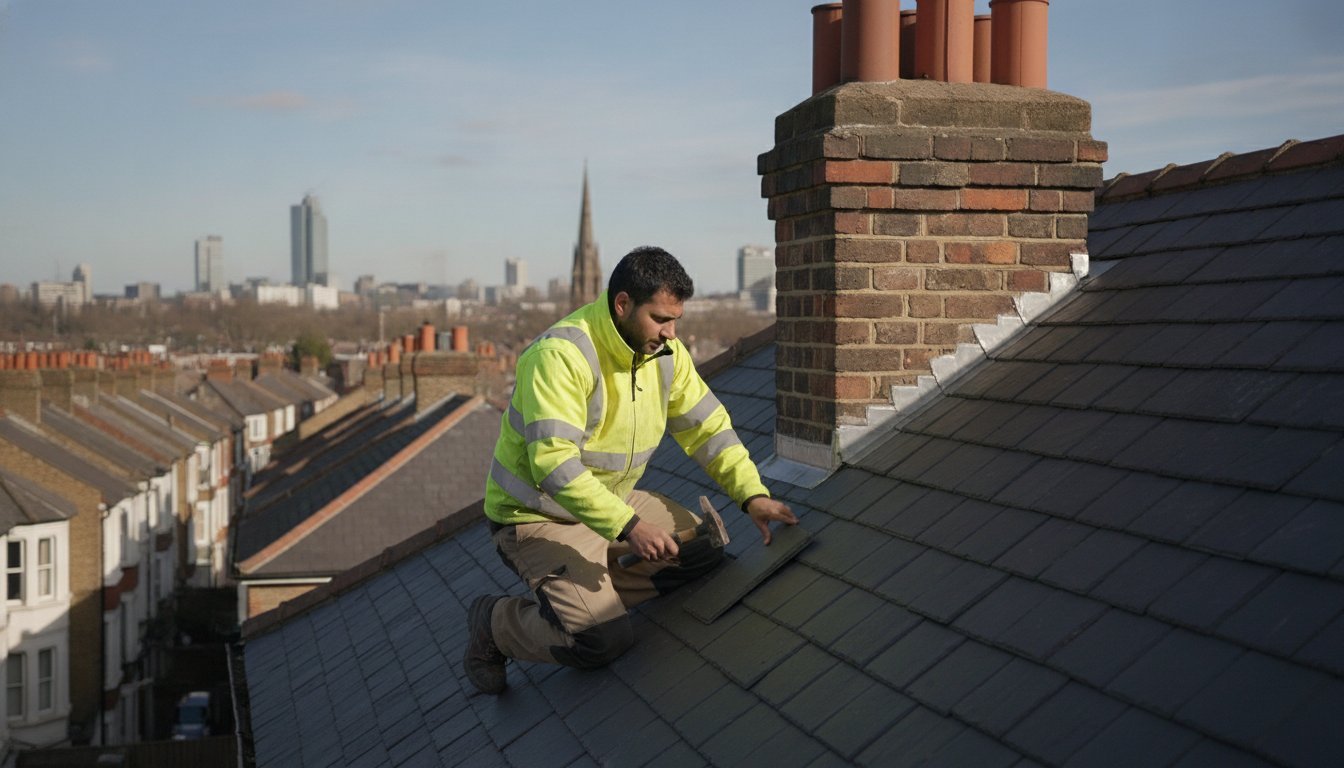
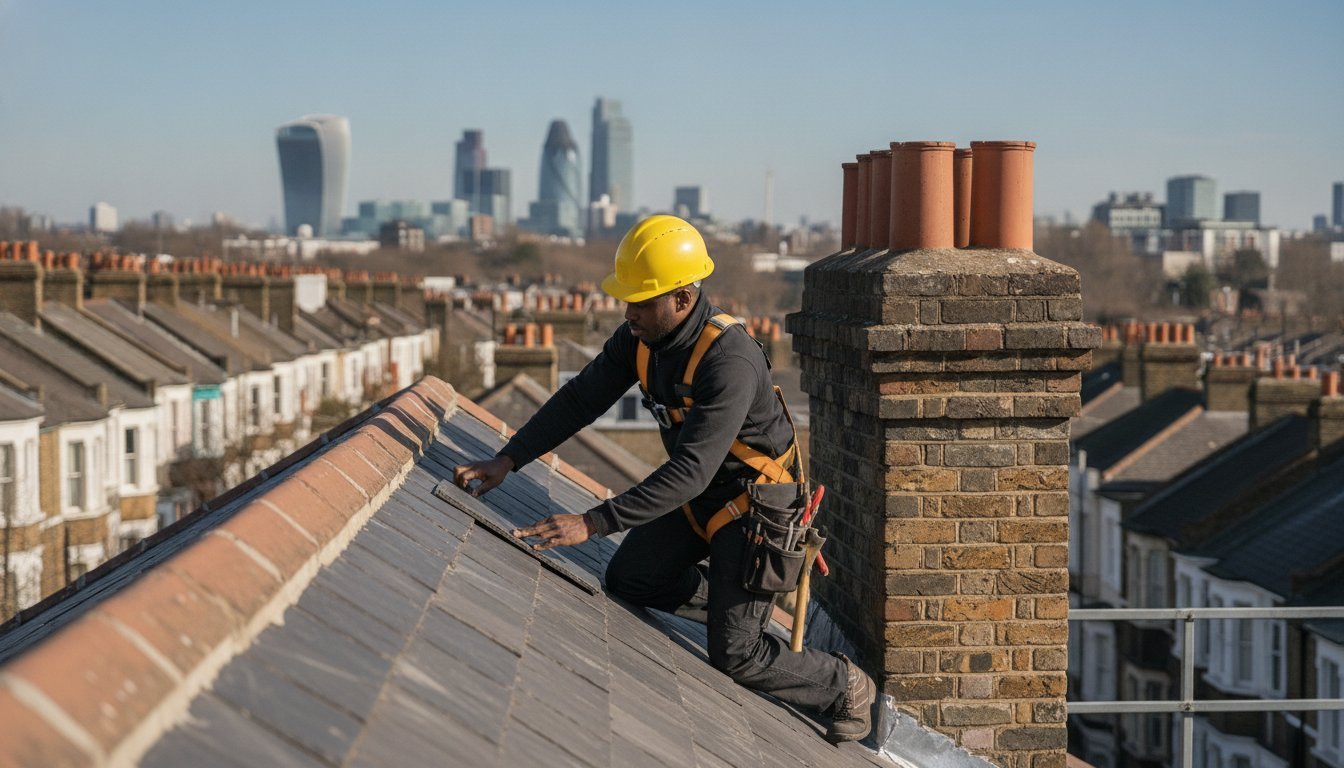
The process begins with a detailed structural survey followed by the careful removal of existing slates or tiles. We then lay the Vapour Control Layer and PIR boards directly over the rafters, creating that continuous thermal blanket mentioned earlier. To secure the system, we install counter-battens that create a vital ventilation gap before fixing new tiling battens. Finally, we re-slate or tile the roof, often using high-quality reclaimed materials to preserve the original Hackney aesthetic. This steady, phased approach ensures the property remains watertight at every stage of the build.
If you are planning a major renovation and need guidance on local regulations, contact our specialist team to discuss how we can manage your Building Control notification and installation.
Securing Your Investment with Roofing in Hackney
Choosing to upgrade your property’s thermal performance is a significant decision that impacts both your daily comfort and the long term value of your home. At Roofing in Hackney, we approach every project with the mindset of a “Master Craftsman,” ensuring that warm roof insulation Hackney installations are executed with technical precision. We don’t simply lay insulation boards and move on; we conduct a comprehensive assessment of your entire roof structure. This integrated approach means we identify and resolve underlying issues, such as weakened timbers or failing masonry, before the new thermal layers are finalised. By doing so, we guarantee that your investment is protected by a roof that is as structurally sound as it is energy efficient.
The financial benefits of these improvements are substantial. Beyond the immediate reduction in monthly heating costs, thermal roof insulation upgrades significantly enhance the desirability of your property in a competitive East London market. A home that can demonstrate superior energy performance and a damp-free environment is a high-value asset. Our local presence across the E8 and E9 postcodes ensures that we provide rapid support and clear accountability. We live and work in the same community as our clients, which drives our commitment to maintaining the highest standards of workmanship on every street we serve.
Why Local Expertise Matters
Hackney’s architectural landscape is dominated by Victorian and Edwardian terraces, each with its own set of structural idiosyncrasies. We understand how these heritage buildings “breathe” and how modern insulation must be carefully integrated to avoid disrupting their natural equilibrium. Our team is well-versed in the specific planning quirks of the borough, ensuring that your project proceeds without regulatory friction. You can learn more about our team and our decades of experience in specialised East London roofing to see how our local knowledge benefits your specific property type.
Next Steps: Your Thermal Consultation
Every Hackney home is unique, which is why we don’t offer one-size-fits-all solutions. The first step toward a warmer, more efficient home is a bespoke structural survey. During this professional consultation, we examine your current roof configuration, measure existing thermal performance, and provide a clear, methodical plan for your upgrade. We prioritise transparency, providing you with a detailed breakdown of the workflow and the expected outcomes for your property. Contact Roofing in Hackney today to arrange your expert warm roof assessment and take the first step toward a more sustainable future for your home.
Future-Proofing Your Hackney Property’s Thermal Performance
Investing in warm roof insulation Hackney represents a definitive step toward a more sustainable and durable home. By shifting the thermal envelope to the exterior of your rafters, you protect the building’s structural timbers from the damp and temperature extremes common in East London. This approach is the most effective way to achieve the 0.16 W/m²K U-value target mandated by the 2026 Building Regulations whilst preserving the valuable internal space of your property.
We bring a Master Craftsman’s precision to every project, specialising in the complex integration of modern insulation with traditional slate roofing and leadwork. Our expertise in Hackney’s heritage terraces ensures that your thermal upgrade is both fully compliant and aesthetically sympathetic to the local area. We’ll provide the technical accountability required to turn a significant structural investment into a lifetime of comfort and energy savings.
Get a Professional Warm Roof Consultation in Hackney to discuss your property’s specific requirements. We’re ready to help you transform your home into a more efficient, damp-free environment.
Frequently Asked Questions
Does warm roof insulation require planning permission in Hackney?
Planning permission is typically not required for installing warm roof insulation Hackney as it falls under permitted development. However, if your property is a listed building or situated within one of Hackney’s many conservation areas, you must consult the local planning authority. We recommend checking the Hackney Council website for specific heritage constraints before commencing any structural work to ensure full legal compliance.
How much can I save on my energy bills with a warm roof system?
Homeowners can achieve substantial reductions in their heating costs because an uninsulated roof accounts for approximately 25% of total heat loss. For a typical 3-bedroom semi-detached house, proper insulation can save up to £730 on annual energy bills according to current efficiency data. These savings are further supported by the 0% VAT rate on insulation products, which remains in effect until 31 March 2027.
Is a warm roof suitable for a Victorian terrace house?
A warm roof system is highly suitable and often the preferred choice for Victorian terraces. By placing the thermal barrier above the rafters, it moves the dew point outside the building’s timber frame. This prevents the moisture buildup and wood rot that frequently affect older properties whilst creating a more comfortable, usable environment in the loft space without the “cold attic” feel of traditional methods.
What is the difference between loft insulation and warm roof insulation?
Traditional loft insulation is installed between the ceiling joists, creating a “cold roof” where the attic remains unheated and exposed to damp. In contrast, warm roof insulation is placed over the rafters, bringing the entire roof structure into the building’s thermal envelope. This method provides superior efficiency, eliminates thermal bridging through the timbers, and protects the roof structure from extreme temperature fluctuations.
How long does it take to install warm roof insulation on a standard Hackney home?
A standard installation on a residential property usually takes between 7 and 14 days to complete. This timeframe includes the initial structural survey, the removal of existing slates or tiles, the installation of the PIR boards and vapour layers, and the final re-covering. We manage the entire process, including scaffolding and safety protocols, to ensure the project moves at a deliberate and efficient pace.
Can I install warm roof insulation on a flat roof extension?
Warm roofs are the industry standard for modern flat roof extensions. This configuration is essential for preventing interstitial condensation, which occurs when moisture is trapped between the roof’s structural layers. It ensures that your extension meets the target U-value of 0.18 W/m²K whilst providing a durable, watertight finish that protects the timber decking and interior ceiling from damp and decay.
What Building Regulations apply to roof insulation in London?
Under Part L of the Building Regulations, any renovation involving more than 25% of a roof’s surface area requires notification to the local Building Control office. The work must meet a target U-value of 0.16 W/m²K for pitched roofs or 0.18 W/m²K for flat roofs as of 2026. Using a specialist contractor ensures you receive the necessary completion certificate, which is vital for property sales and insurance.
Will warm roof insulation help prevent damp and mould in my home?
This system is one of the most effective ways to permanently eliminate damp and mould in your loft. By keeping the internal surfaces warm, it prevents the condensation that forms when warm, moist air hits cold rafters. This structural solution addresses the root cause of mould growth, ensuring a healthier living environment and preserving the long term integrity of your roof timbers.