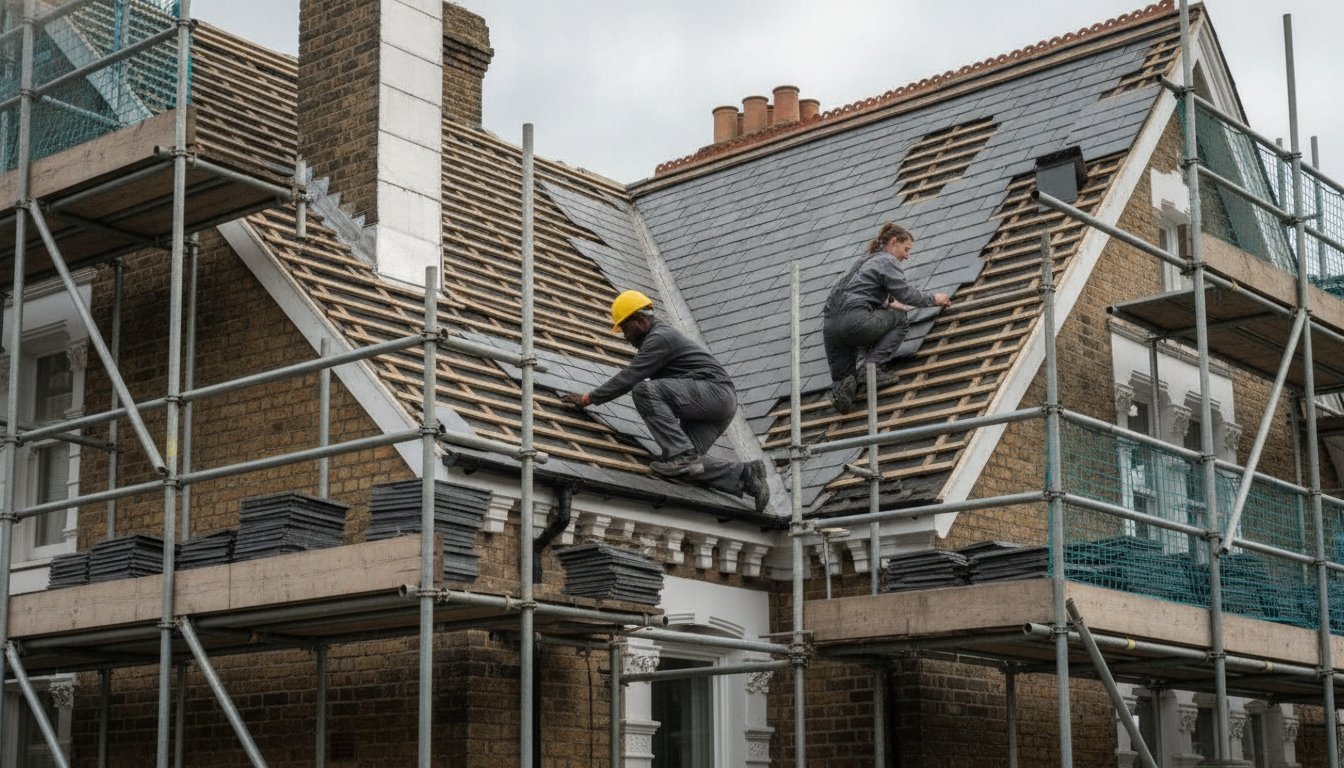
Why do two seemingly identical Victorian terraces on the same street often produce a full roof replacement cost Hackney homeowners find difficult to reconcile? It’s a frustrating reality for those who recognise that London labour and the logistical hurdles of narrow East London streets already command a premium. You’re right to feel anxious about the “unseen” elements, such as decaying valley gutters or structural joist failure, which can quickly turn a standard project into a financial headache.
This guide offers a comprehensive breakdown of the structural and material factors that define a professional roofing budget in 2026, specifically tailored for the unique demands of our local period architecture. We’ll provide the clarity you need to move from uncertainty to a weather-tight, compliant home. We start by deconstructing the essential components of a professional estimate, from Hackney Council’s conservation area permits and complex scaffolding requirements to the high-grade leadwork and timber repairs that ensure your property remains a safe investment for decades to come.
Key Takeaways
- Understand how 2026 London labour rates and material choices influence the full roof replacement cost Hackney homeowners can expect to pay for their specific property type.
- Learn why scaffolding and logistics on narrow East London streets can account for nearly a third of your total budget and how to plan for these essential site costs.
- Discover how to identify structural deflection and when “sistering” techniques are required to reinforce aging Victorian timber frames.
- Navigate the complexities of Hackney’s unique architectural styles, including the specific requirements for butterfly roofs and party wall agreements.
- Gain the expertise to evaluate professional quotes effectively, ensuring your project meets Building Regulations whilst avoiding the risks of hidden “extra” charges.
Calculating the Full Roof Replacement Cost in Hackney (2026)
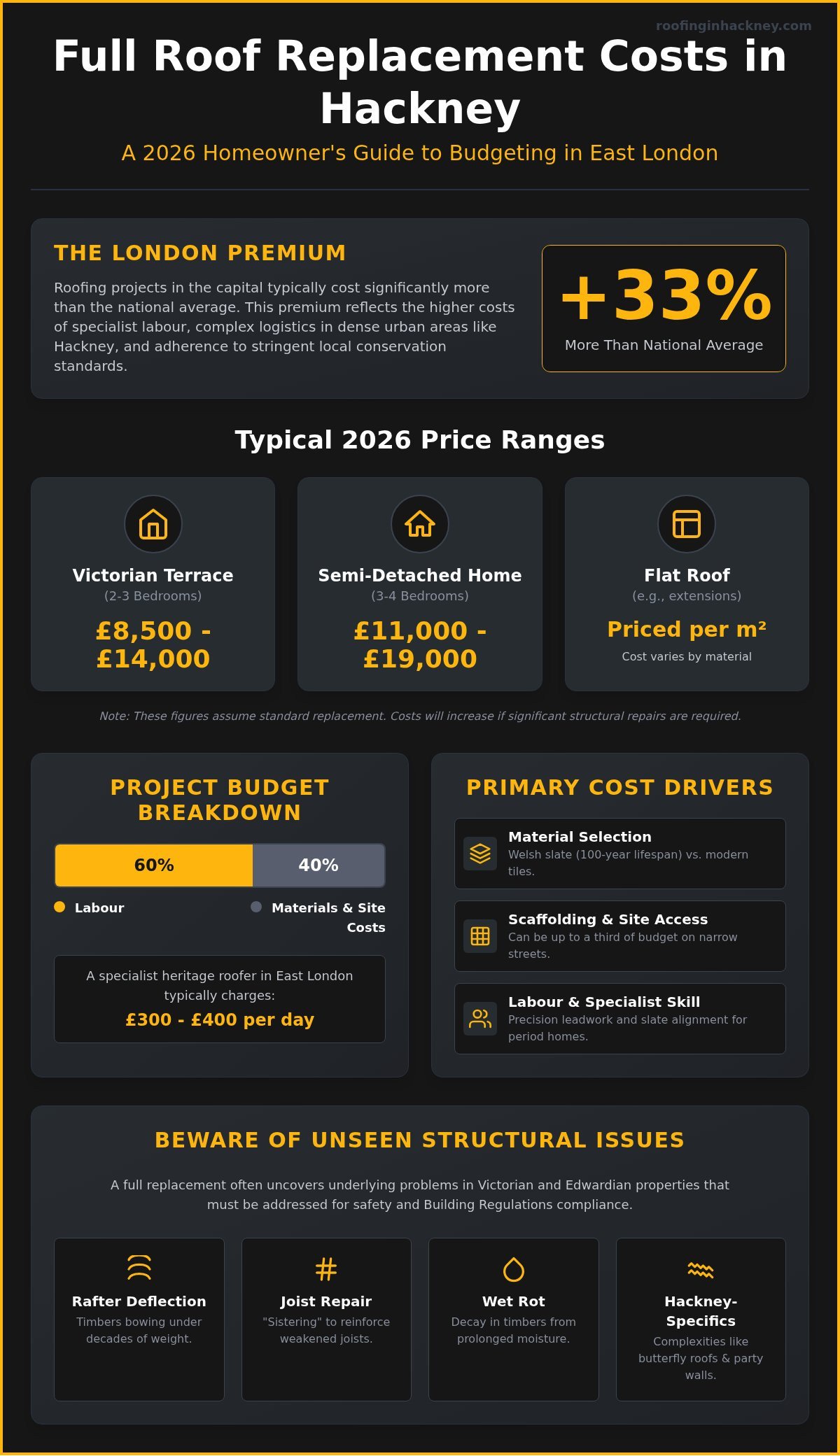
Estimating the full roof replacement cost Hackney homeowners face involves more than a simple calculation of square footage. In 2026, the London market continues to command a distinct premium. Industry data indicates that roofing projects in the capital typically cost 33% more than the national average. This isn’t just a “London tax”; it reflects the higher cost of specialist labour, the logistical complexity of E8 and N1 postcodes, and the stringent requirements of Hackney Council’s conservation standards. When you invest in a new roof in East London, you’re paying for the expertise required to manage these unique regional variables.
A common misconception is that a replacement only involves the external “skin” of the building. In reality, when we strip back the old materials on a property that hasn’t been touched in forty years, we often find that the structural integrity is compromised. Over decades, the weight of heavy tiles can cause rafters to deflect. Addressing these issues during the replacement phase is non-negotiable for Building Regulations compliance and long-term safety.
2026 Price Estimates by Property Type
Property style is the primary variable in any estimate. Victorian terraces, which dominate much of Hackney, often present specific challenges due to their steep pitches and high-density locations. Below are the typical investment ranges for the current year:
- Victorian Terrace (2-3 bed): Estimates typically range from £8,500 to £14,000.
- Semi-Detached (3-4 bed): These larger footprints usually fall between £11,000 and £19,000.
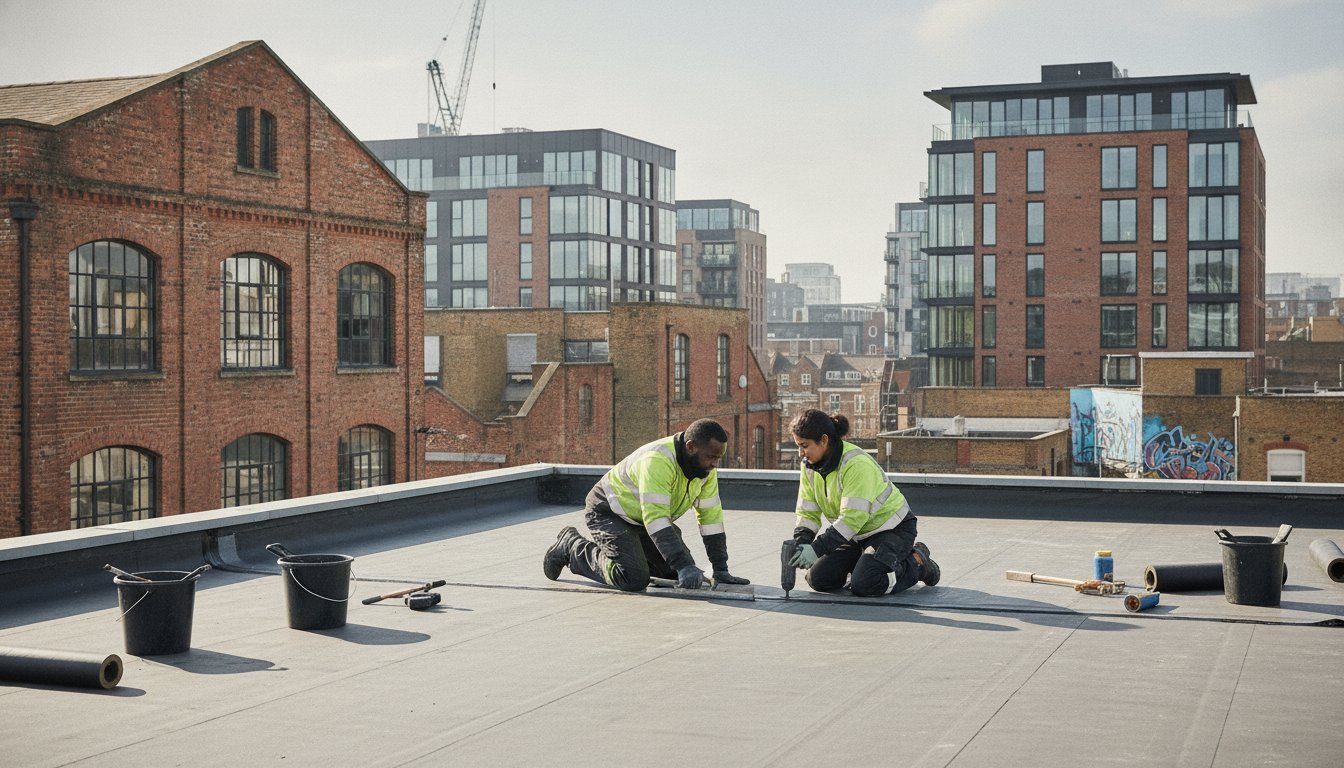
- Flat Roof Replacement: These are generally calculated based on the specific membrane material and square metreage.
These figures assume a standard replacement. However, many period homes require remedial work on the underlying UK domestic roof construction. If rafters have bowed or joists show signs of wet rot, the cost will naturally shift toward the higher end of these ranges. Identifying these structural needs early is essential for an accurate full roof replacement cost Hackney assessment.
Supply vs Labour: The Cost Split
The budget for a Hackney project is roughly split 60/40 between labour and materials. In 2026, a specialist roofer focused on heritage properties in East London typically charges between £300 and £400 per day. This reflects the technical skill required for precision leadwork and slate alignment on historic buildings.
Material costs have also seen steady inflation. Natural Welsh slate remains the gold standard for longevity, though high-quality clay tiles are a frequent requirement in Hackney’s 35 conservation areas. Beyond the roof itself, you must account for waste management. A skip permit from Hackney Council, coupled with potential parking suspension fees on narrow residential streets, can add several hundred pounds to the final bill. For a detailed breakdown of how these factors apply to your specific street, you can contact us for a professional assessment.
Primary Cost Drivers: Materials, Labour, and the Scaffolding Factor
Whilst the previous section outlined broad property estimates, the specific full roof replacement cost Hackney homeowners pay is dictated by three primary variables: material choice, labour intensity, and site access. In a dense urban environment like East London, these factors don’t operate in isolation. A choice of heavy traditional slate, for example, requires a more robust structural assessment and a higher degree of labour skill than modern interlocking concrete tiles. Understanding how these elements interact allows you to prioritise your budget effectively without compromising on the building’s long-term health.
Material Selection and Longevity
For the many Victorian and Edwardian terraces in our area, natural Welsh slate remains the preferred choice for its hundred-year lifespan and aesthetic compliance with local conservation standards. Although the initial outlay for slate is higher than concrete or clay alternatives, its durability often provides the best value over the life of the property. For those seeking modern efficiency, integrating thermal roof insulation upgrades during the replacement process is a logical step. This not only improves your home’s energy rating but also ensures your project meets the latest environmental standards whilst the roof is already stripped back.
Access and Scaffolding Complexity
In Hackney, scaffolding is rarely a straightforward line item. Because of our narrow streets and multi-storey heights, scaffolding often accounts for 20% to 30% of the total project bill. If the structure needs to sit on a public pavement, we must secure a specific pavement licence from Hackney Council, which carries its own fees and lead times. This “Scaffolding Factor” is a significant driver of the full roof replacement cost Hackney residents must consider. Any delay in the material supply chain can lead to mounting weekly hire charges, which is why we prioritise a methodical, process-driven workflow to keep the timeline as tight as possible.
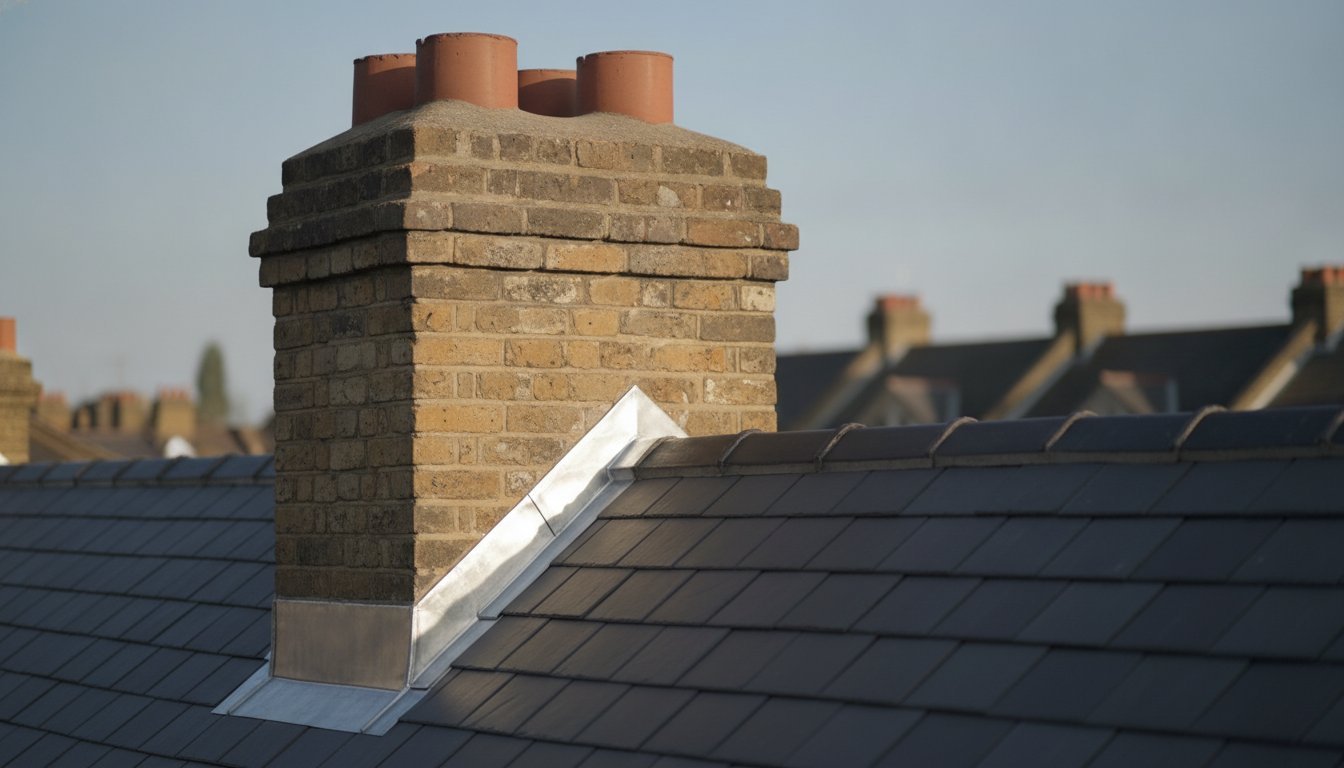
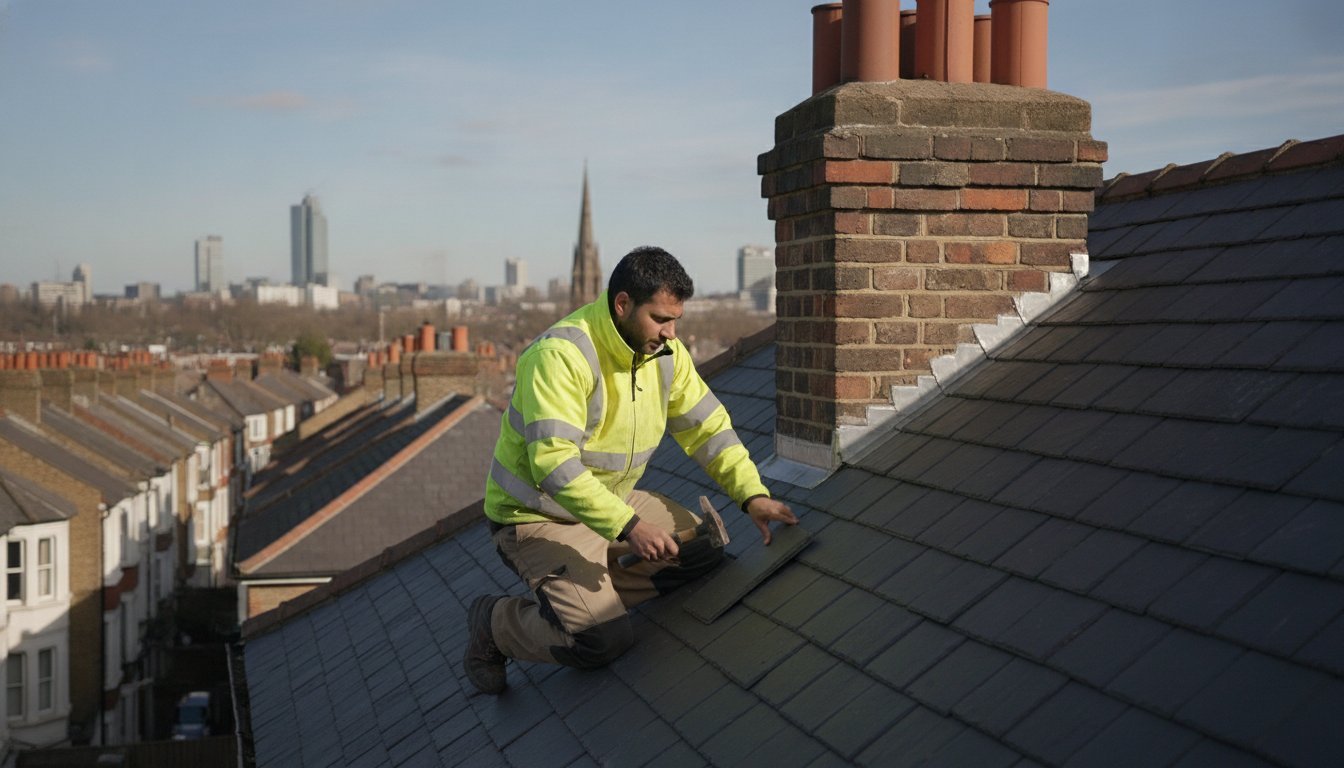
Beyond the main roof covering, “forgotten” costs like leadwork and chimney repairs frequently arise. Replacing old, perished lead flashings in valleys and around chimney stacks is essential for a weather-tight finish. Furthermore, any significant work must adhere to the official building regulations for roofing, which may require a formal sign-off from a building control officer. To ensure every structural detail is captured in your initial estimate, it’s often wise to request a detailed site survey from a local specialist who understands the nuances of East London’s period housing stock.
Structural Realities: The Cost of Repairing Roof Joists and Timbers
A roof is only as resilient as the skeleton supporting it. In many of East London’s Victorian and Edwardian properties, the original timber frameworks have reached the end of their functional lifespan. When calculating the full roof replacement cost Hackney homeowners must look beyond the tiles and slates to the rafters and joists beneath. If these structural members are compromised by rot or deflection, installing a new covering without addressing the timber is a recipe for total roof failure. We prioritise a “structure-first” approach, ensuring the building’s crown is as strong as it is weather-tight.
Diagnosing Joist Failure
Identifying structural issues requires a keen eye for detail. We often find “deflection” in older roofs, where the rafters have bowed under the weight of decades of weather or, more commonly, the historical replacement of light slate with heavy concrete tiles. Wet rot and woodworm are also frequent guests in unventilated loft spaces. If we detect significant decay in the wall plates or major structural beams, the project complexity increases. Adhering to the standards set by the National Federation of Roofing Contractors ensures that these structural repairs meet modern safety benchmarks. For properties with severe sagging, a structural engineer may be required to sign off on the calculations for Building Regulations approval.
Research suggests that the average cost to repair or reinforce a single roof joist is approximately £575, with prices typically ranging between £350 and £600 per beam. Whilst this adds to the initial full roof replacement cost Hackney residents budget for, it prevents the catastrophic expense of a structural collapse later. Ignoring these signs doesn’t just risk your property; it risks the safety of the occupants.
Step-by-Step: Structural Timber Repair
Our methodology for timber restoration is methodical and transparent. We don’t believe in shortcuts when it involves the integrity of your home.
- Step 1: Exposing the damaged structural members. We strip back the old covering and felt to gain full access to the rafters and wall plates.
- Step 2: Chemical treatment and removal. Decayed timber is carefully removed, and the surrounding areas are treated with industrial-grade fungicides to prevent future rot.
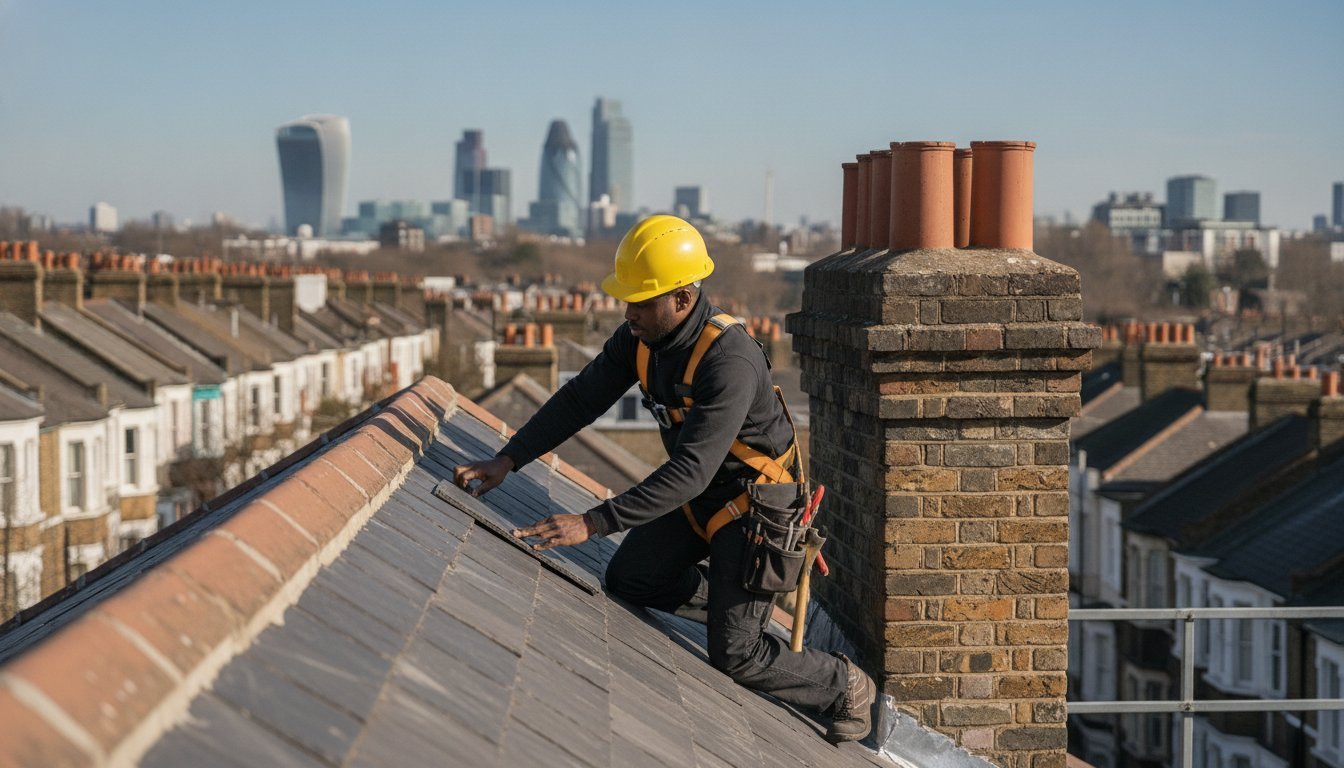
- Step 3: Sistering with C24 timber. We apply the “sistering” technique, where new, high-strength C24 grade structural timber is bolted directly to the existing joists. This reinforces the frame without the need for a disruptive total rebuild.
- Step 4: Alignment and levelling. We ensure the new structure is perfectly level, providing a flat, stable surface for the new battens and tiles.
This process ensures your roof doesn’t just look new but performs like a modern installation. If you’ve noticed a dip in your roofline or damp patches on your top-floor ceilings, it’s time for a professional assessment. You can request a structural survey to identify exactly what’s happening beneath your tiles.
Specialist Challenges for Hackney Period Properties
Replacing a roof in East London is rarely a “one-size-fits-all” task. The full roof replacement cost Hackney homeowners encounter is often influenced by the borough’s unique architectural heritage. Unlike modern suburban builds, our local housing stock features complex designs like the “Butterfly” or “Valley” roof, where two roof slopes angle inwards towards a central gutter. These structures require precision leadwork and a deep understanding of historical drainage patterns to prevent internal leaks that can devastate period plasterwork.
A significant factor in these projects is the Party Wall Act. Because most Hackney terraces share structural elements with neighbours, any work affecting a shared chimney stack or party wall requires formal notification. This legal requirement ensures that your project doesn’t compromise the stability of the adjoining property. Navigating these nuances requires a contractor with specific local experience in mastering slate roofing in Hackney, as traditional aesthetics must be maintained whilst meeting 2026 safety standards.
Victorian Terrace Roof Structures
The “Butterfly” roof design is a hallmark of local Victorian architecture, but it presents specific structural risks. The central internal valley is a frequent point of failure. If the lead lining perishes, water ingress often goes unnoticed until it has saturated the soft pine joists common to these 19th-century builds. Once damp takes hold in these timbers, the structural integrity of the entire roof is at risk. Shared chimney stacks also present a challenge; if a neighbour’s side of the stack is neglected, it can lead to dampness on your newly repaired side. We always assess these shared elements during our initial survey to ensure your individual replacement isn’t undermined by adjacent decay.
Local Regulations and Building Control
Hackney is home to 35 conservation areas and over 500 listed buildings. This means that matching traditional materials isn’t just an aesthetic choice; it’s often a legal requirement. You must notify Hackney Council’s building control department for any structural roof work or if you’re replacing more than 25% of the roof area. This process ensures that the building meets modern standards for thermal efficiency and structural load-bearing. Our team has extensive experience working within these constraints, which you can read more about on our About Us page. We handle the technical documentation required to prove that your new roof is both historically sympathetic and fully compliant with the latest Building Regulations.
If your property is within a conservation area or you’re concerned about how a shared structure might affect your project, it’s essential to get expert advice early. You can request a heritage-led consultation to ensure your replacement is planned with both legal and structural precision.
Planning Your Project: Quotes, ROI, and Reliability
Navigating the final stages of a project requires a shift from technical research to commercial due diligence. Whilst the initial full roof replacement cost Hackney estimates provide a baseline, the ultimate value of your investment is determined by the quality of the execution and the transparency of the contractor. A professional roof replacement in Hackney isn’t merely a repair; it’s a strategic upgrade that safeguards your property’s structural integrity and market value for the next half-century. In our local market, where period homes are highly prized, a certified and historically sympathetic roof is a significant asset during any future property valuation.
Be wary of the “cheapest quote” trap that often circulates in general building circles. These estimates frequently omit the complex structural timber work or high-grade leadwork discussed in earlier sections. This leads to significant price hikes once the roof is already stripped and the homeowner is at their most vulnerable. A low-cost bid often indicates a lack of understanding regarding Hackney’s specific conservation requirements or, worse, an intention to cut corners on the structural “sistering” of joists that ensures your roof remains level and safe.
What to Look for in a Professional Quote
A professional bid should be an exhaustive document that leaves no room for “unforeseen” extras. In the 2026 London market, an “all-in” estimate must be specific. Your quote should explicitly list the following items to ensure you aren’t hit with hidden charges:
- Scaffolding design, pavement licences from Hackney Council, and confirmed weekly hire rates.
- Waste disposal, including skip permits and the removal of hazardous old materials.
- Comprehensive public and employers’ liability insurance.
- Specific timber treatment protocols and long-term structural guarantees.
If these elements are missing or described vaguely, the quote is incomplete. You can contact us for a transparent, itemised assessment that covers every structural and aesthetic detail of your specific property.
Future-Proofing Your Investment
A new roof offers a unique window to improve your home’s thermal performance. By combining your replacement with modern insulation upgrades, you reduce long-term energy costs and ensure compliance with evolving Building Regulations. Peace of mind in the London market comes from a comprehensive structural guarantee. This isn’t just a promise; it’s a technical certification of the work performed on your rafters and joists.
Longevity also depends on post-installation care. Regular maintenance, such as annual gutter clearing and inspecting lead valleys, will extend the life of your slate roofing and protect the timbers we’ve reinforced. Choosing a specialist who understands Hackney’s specific period requirements ensures that your roof remains a durable, weather-tight crown for your home, rather than a recurring maintenance liability. This methodical approach to planning ensures that your full roof replacement cost Hackney investment delivers the highest possible return in both safety and property value.
Securing Your Hackney Home’s Structural Future
Investing in a new roof is a significant decision that defines the longevity and safety of your property. As we’ve explored, the full roof replacement cost Hackney residents face in 2026 is a direct reflection of the borough’s unique period architecture and the technical precision required for structural timber repairs. By prioritising high-quality materials and expert craftsmanship over the cheapest quote, you ensure your home remains weather-tight and compliant with all modern Building Regulations for decades to come.
Our specialist Hackney heritage roofers bring expert local knowledge of East London period properties to every project. Whether we’re performing fully insured structural repairs or intricate leadwork, our focus remains on long-term value and technical proficiency. Don’t settle for generalist builders who might miss the subtle signs of joist failure or ignore conservation area constraints that could lead to future legal complications.
Get a Professional Roof Replacement Quote in Hackney today to begin your project with confidence. We’re here to help you protect your investment with the care and technical mastery of a true master craftsman.
Frequently Asked Questions
How much does it cost to replace a roof on a Victorian terrace in Hackney?
Calculating the full roof replacement cost Hackney residents expect for a 2-3 bedroom Victorian terrace typically results in a range from £8,500 to £14,000. This estimate accounts for the complexity of East London’s historical architecture and the high standards required for heritage slate work. The final figure depends on whether you choose traditional Welsh slate or modern clay tiles. Chimney repairs and leadwork in internal valleys will also influence the total investment for your property.
Can I stay in my house whilst a full roof replacement is being carried out?
You can typically remain in your property throughout the duration of the works. Since the vast majority of a roof replacement is conducted externally, your daily routine shouldn’t be significantly interrupted. However, you should prepare for increased noise levels during daylight hours and some dust in the loft space. If your project involves extensive structural joist replacement, we may briefly require access to top-floor ceilings to ensure internal safety and alignment.
Do I need planning permission for a full roof replacement in Hackney?
Planning permission isn’t usually required if you’re replacing like-for-like materials under Permitted Development rights. However, Hackney contains 35 conservation areas and over 500 listed buildings where stricter rules apply. If you intend to change the roof’s height or significantly alter the materials, you must consult Hackney Council. Regardless of planning, you must always ensure the work complies with Building Regulations regarding thermal insulation and structural load-bearing capacity.
How long does a full roof replacement take for a standard London property?
A standard full replacement for a London terrace usually takes between 7 and 14 working days. This timeline includes the initial scaffolding erection, stripping the old materials, and installing the new structural felt, battens, and tiles. Complex projects involving internal “butterfly” valleys or extensive timber sistering can extend this duration. Weather conditions also play a critical role, as we must ensure the building remains weather-tight during the transition phases.
What is the difference between re-roofing and a full structural replacement?
Re-roofing involves replacing the external tiles and felt, whilst a full structural replacement addresses the underlying rafters and joists. Many homeowners find that the full roof replacement cost Hackney contractors quote includes these structural repairs because original Victorian timbers have often deflected over time. Re-roofing is a cosmetic fix; structural replacement is a long-term investment in the building’s skeleton that ensures the new covering doesn’t sag or fail prematurely.
Is roof joist repair covered by home insurance in the UK?
Standard home insurance policies typically exclude repairs for roof joists caused by gradual deterioration, wet rot, or woodworm. These issues are generally classified as maintenance responsibilities rather than sudden accidents. You may be successful with a claim if the structural damage is the direct result of a specific event, such as a fire or a fallen tree during a storm. We always recommend reviewing your policy’s “buildings cover” section for specific exclusions.
How much does scaffolding cost for a roof replacement in London?
Scaffolding costs for a typical London project range from £500 to £1,200, though Hackney’s specific logistics often increase this. If the structure must stand on a public pavement, you’ll need a local authority licence which adds to the expense. For multi-storey terraces or properties with difficult access, scaffolding can represent up to 30% of your total budget. This reflects the specialised safety equipment and permits required for working on narrow urban streets.
What happens if I ignore a sagging roof joist?
Ignoring a sagging joist leads to progressive structural failure and significantly higher repair bills. A dip in the roofline suggests that the timber is no longer supporting the weight of the tiles, which can cause the roof covering to crack and leak. Over time, this moisture accelerates rot in the remaining healthy timbers and can eventually lead to a partial collapse. Addressing deflection early through sistering techniques is far more cost-effective than a total rebuild.