A water stain on the ceiling from a roof leak is rarely just a cosmetic blemish; in Hackney’s Victorian and Edwardian terraces, it is often the first visible sign of a structural failure that has been developing for months. It’s natural to feel a sense of dread when you spot that tell-tale yellow ring, especially with current data showing that dampness and mould now affect roughly 23% of UK households. You aren’t just worried about the paintwork; you’re concerned about the health risks of mould spores and the potential for rogue traders to offer temporary patches rather than lasting, professional solutions.
We understand that your home is a significant investment that requires a methodical, expert-led approach to maintenance. This article will help you identify whether your ceiling damage indicates a minor tile slip or a more serious failure of heritage materials, providing you with the clarity needed to protect your property’s long-term value. We will preview the diagnostic steps used by master craftsmen to confirm the source of ingress, whilst detailing the professional repair workflows required to restore structural integrity and the essential measures to prevent future mould growth amongst the rafters of your Hackney home.
Key Takeaways
- Learn how to distinguish between historic damage and an active water stain on the ceiling from roof leak by identifying characteristic yellowish-brown tide-marks.
- Understand why Hackney’s Victorian architecture is uniquely susceptible to failures like cracked lead flashing and slipped slates that allow driving rain ingress.
- Discover the structural and health implications of ignoring damp, including the development of wet rot in timber joists and the proliferation of harmful mould spores.
- Recognise the value of a master craftsman’s approach to restoration, prioritising precision leadwork and slate replacement over temporary cosmetic patches.
- Implement a proactive maintenance strategy to protect your property’s structural integrity and ensure your home remains watertight and energy efficient.
Is Your Ceiling Water Stain Caused by an Active Roof Leak?
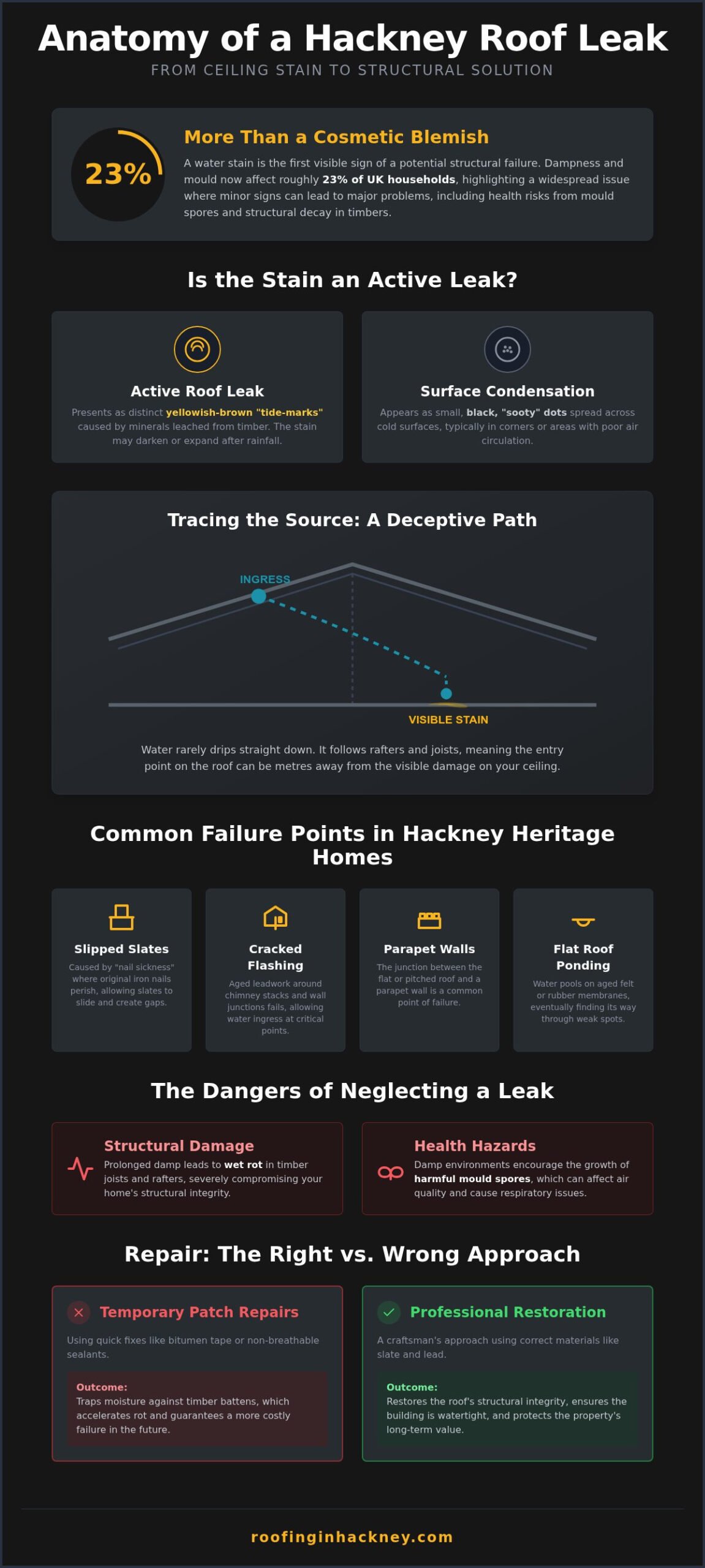
Identifying a water stain on ceiling from roof leak requires a methodical eye. Unlike the grey, speckled patterns of surface condensation, an active leak typically presents as a distinct “tide-mark.” These yellowish-brown rings are caused by tannins and minerals being leached from the building’s timber rafters and plaster as water percolates through the structure. When heavy East London rain hits, these stains often darken or expand, confirming that the external envelope has been breached. Understanding what is water damage in a structural context is essential for any Hackney homeowner aiming to preserve their property’s heritage.
The location of the stain can be deceptive. Due to the pitch of traditional slate roofs, water rarely drips straight down. Instead, it follows the path of least resistance; it often runs along rafters or joists for several metres before pooling on the plasterboard. This means the entry point on your roof might be far from the visible damage in your bedroom or hallway. A master craftsman understands that the stain is merely the exit point, and the true diagnosis begins by tracing the moisture path back to the source.
Mould vs. Damp: Spotting the Warning Signs
It is vital to distinguish between atmospheric moisture and structural ingress. Condensation mould usually appears as small, black, “sooty” dots spread across a cold surface, often in corners with poor airflow. Conversely, a roof leak creates a saturated zone. You should look for a yellowish-brown halo surrounding a central damp patch. If you can access your loft, check for saturated insulation; it often emits a sharp, musty odour long before the water reaches the ceiling below. If the stain expands significantly after a storm, the diagnosis of a roof failure is almost certain.
Common Locations for Leak-Induced Stains
In Hackney’s period terraces, certain areas are more prone to failure. We frequently observe staining in the following locations:
- Upper-floor ceilings: Damage directly beneath the main roof void often indicates slipped slates or perished underlay.
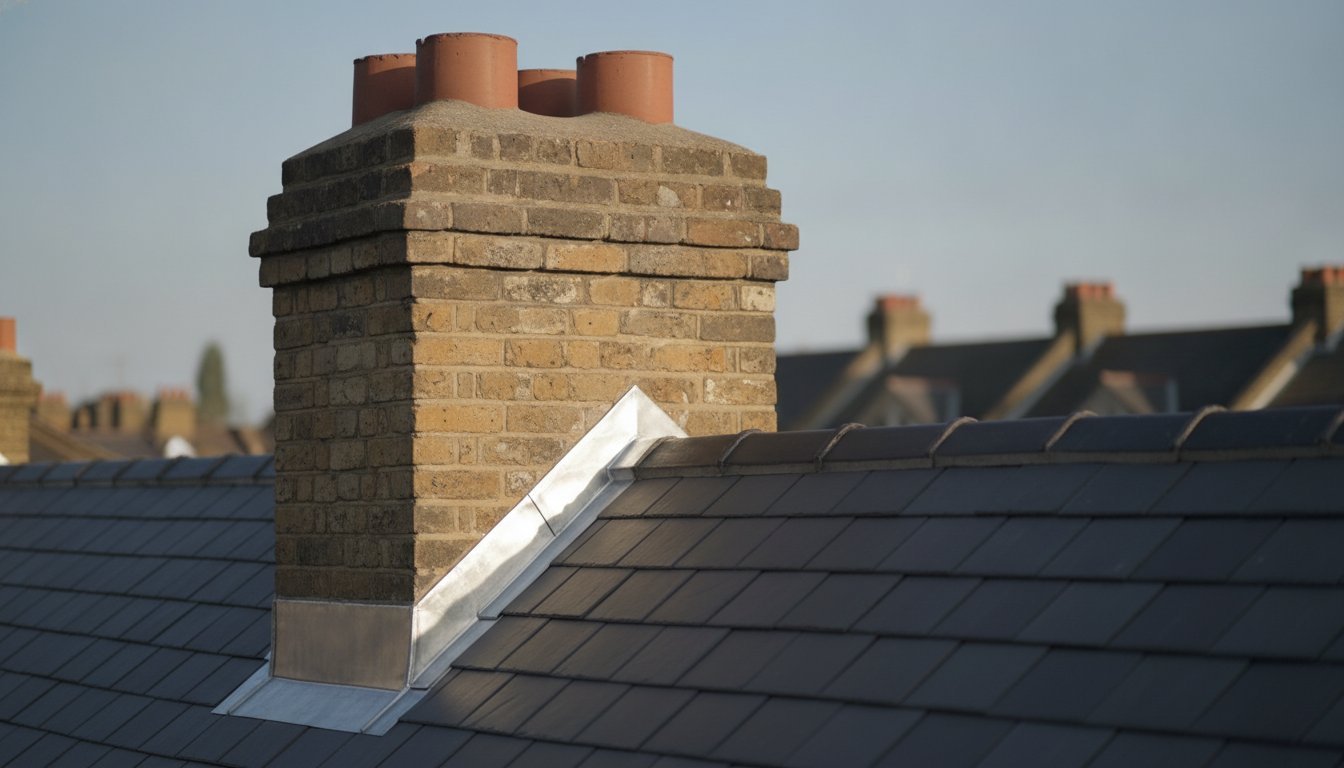
- Chimney breasts: Staining here usually points to cracked lead flashing or failing mortar in the chimney stack.
- Parapet walls: Water often enters through the junction between the wall and the roof, especially if the leadwork is aged.
- Flat roof extensions: These are susceptible to “ponding,” where water pools and finds its way through aged felt or rubber membranes.
If you have identified these signs in your property, you can contact us to arrange a professional assessment. Addressing these vulnerabilities early prevents the moisture from compromising your home’s structural integrity.
Identifying the Source: Common Hackney Roof Failures
A water stain on the ceiling from a roof leak is merely the symptom. To resolve the issue permanently, we must identify the specific failure point within Hackney’s unique architectural landscape. Many local properties feature original slate roofs that have braved the elements for over a century. Whilst these materials are incredibly durable, they aren’t immortal. Identifying the source requires a methodical inspection of the roof’s “weak points,” where age and weather most frequently breach the building’s defences.
Slate and Tile Vulnerabilities in East London
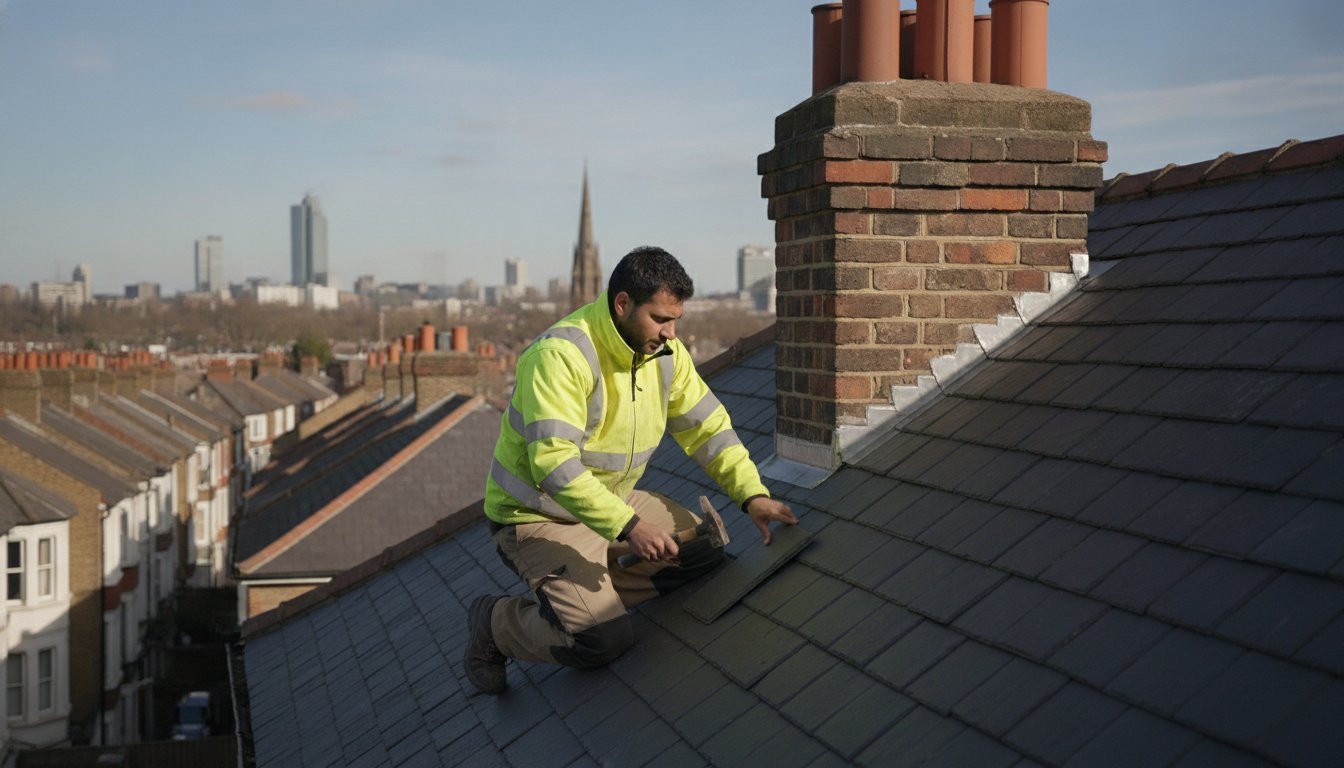
In Victorian and Edwardian terraces across Hackney, the most frequent cause of ingress is a phenomenon known as “nail sickness.” This occurs when the original iron nails used to secure slates oxidise and perish over time. As the nails fail, slates begin to slip, creating gaps that allow driving rain to penetrate the roof’s internal structure. It’s a systemic issue that often signals the entire roof covering is reaching the end of its functional life.
Homeowners often fall into the trap of using cheap “patch” repairs, such as bitumen tape or non-breathable sealants. These temporary fixes often trap moisture against the timber battens, which can accelerate rot in the roof’s skeleton. For those living in conservation areas or heritage properties, understanding the nuances of traditional materials is vital for a long-term fix. You can read more about these specific requirements in our guide to Mastering Slate Roofing in Hackney.
Leadwork and Chimney Stack Issues
Lead is the primary defence for the complex junctions of a roof, specifically the valleys, parapets, and chimney abutments. Over decades, lead sheets can thin due to constant thermal expansion and contraction, eventually leading to hairline cracks. These fractures are often invisible from the ground but are a direct cause of a persistent water stain on the ceiling from a roof leak. Because water travels along the lead’s underside, the internal stain may appear several feet away from the actual crack.
Chimney stacks present their own set of challenges. Degraded mortar between chimney pots or bricks can act like a sponge, “wicking” moisture down into the property through capillary action. This is why professional repointing is just as important as the leadwork itself. Precision leadwork and chimney repair are specialist crafts that require a steady hand and a deep understanding of historical building techniques. If you suspect your chimney is the culprit, you should arrange a specialist inspection to confirm the integrity of the flashing and masonry.
Finally, don’t overlook the gutters. In East London, where Victorian eaves are often narrow, blocked guttering can cause water to back up under the lower slates. This “over-spill” bypasses the main roof covering entirely, leading to damp patches along the perimeter of your rooms. A simple clearance can sometimes resolve what looks like a major structural failure.
The Structural and Health Risks of Ignoring Ceiling Mould
Ignoring a water stain on ceiling from roof leak is a gamble with your property’s core structure. Whilst it might seem like a minor aesthetic flaw that a coat of stain-block paint can fix, the moisture trapped behind the plaster acts as a catalyst for deeper decay. In Hackney’s period homes, where structural timbers have often survived for over a century, introducing persistent dampness can trigger a rapid decline in integrity. What starts as a small yellowish ring can quickly become the precursor to significant financial and physical risk.
Structural Integrity and Timber Rot
When water bypasses the roof covering, it typically saturates the ceiling joists before it ever reaches the plasterboard. This creates the perfect environment for “wet rot,” a specific type of fungal decay that thrives in timber with a moisture content consistently over 20%. Unlike the visible stain in your living room, this rot occurs on the “dark side” of the ceiling, hidden within the floor or roof void. If left unaddressed, these joists lose their load-bearing capacity, potentially leading to partial ceiling collapses or sagging floors above. The transition from a minor repair to a full-scale structural replacement happens much faster than most homeowners anticipate.
Health and Air Quality Concerns
Mould isn’t just a visual nuisance; it represents a genuine risk to indoor air quality. Every time you open your loft hatch or the air circulates through gaps in the ceiling, microscopic spores are released into your living space. These spores can exacerbate respiratory conditions and are particularly hazardous for children or the elderly. Simply scrubbing the surface with bleach is a temporary aesthetic fix. It fails to neutralise the colony growing deep within the saturated insulation or on the timber rafters. Only by restoring the roof to a watertight state and removing the moisture source can you permanently stop the lifecycle of these spores.
Beyond health and safety, there is the matter of financial protection. Professional surveyors are trained to spot the signs of a poorly managed water stain on ceiling from roof leak during property valuations. A visible stain often triggers a “red flag” on homebuyer reports, which can lead to significant price renegotiations or even the withdrawal of mortgage offers. Addressing the leak today isn’t just about maintenance; it’s about safeguarding your home’s market value. If you’re worried about the extent of the damage, contacting an expert for a structural assessment is the most reliable way to prevent an avoidable full roof replacement in the future.
Professional Remediation: Why a Permanent Fix is Essential
A water stain on ceiling from roof leak is often met with the temptation of a quick DIY fix. Whilst retail sealants and bitumen tapes are marketed as convenient solutions, they frequently exacerbate structural issues by trapping moisture against heritage timbers. A master craftsman understands that a permanent resolution requires looking beyond the visible stain. Our approach involves a comprehensive survey of the entire roof structure to identify not just the point of ingress, but any underlying vulnerabilities that could lead to future failures. This systematic perspective ensures that your investment provides long-term security rather than a series of recurring expenses.
Effective remediation follows a logical, methodical sequence to restore your home’s integrity. Once the external breach is secured with professional slate or leadwork, we address the internal damage. This process typically includes:
- Removal of contamination: Stripping away saturated plasterboard and insulation that has become a breeding ground for mould.
- Timber treatment: Inspecting the joists for wet rot and applying specialist fungicidal protectors to neutralise latent spores.
- Structural drying: Ensuring the roof void is completely dry before any cosmetic restoration begins.
This thoroughness is what distinguishes a professional restoration from a temporary patch, preventing the return of dampness and protecting your family’s health.
The Professional Repair Process
Our workflow begins with a technical inspection of Hackney’s specific building stock, ensuring that any replacement materials match the existing architectural style. Whether it involves precision leadwork for a chimney stack or sourcing matching Welsh slates for a Victorian terrace, we prioritise aesthetic harmony and technical longevity. You can learn more about our commitment to craftsmanship on our About Roofing in Hackney page. This process ensures the property remains watertight whilst strictly adhering to local conservation standards.
Beyond the Leak: Insulation and Ventilation
Restoring the roof is only half the battle. To prevent mould from returning, we must address the balance between thermal efficiency and airflow. Modern Thermal Roof Insulation Upgrades play a dual role; they reduce heat loss whilst helping to regulate the temperature of the roof void. However, a watertight roof must also be a breathable one. We ensure that soffit vents or ridge ventilation are correctly positioned to allow moisture-laden air to escape, preventing the stagnant conditions where condensation-based mould thrives.
If you have discovered a persistent damp patch or a growing stain, don’t wait for the damage to spread into the structural timbers. You can request a professional roof survey today to secure your property’s future and ensure a permanent, high-quality resolution.
Preventing Future Mould with Regular Roof Maintenance
A water stain on ceiling from roof leak is a reactive signal that the building’s primary defence has already been compromised. Whilst the immediate repairs discussed in previous sections restore the watertight seal, the most resilient Hackney homes are managed through a strategy of proactive care. Annual inspections are particularly vital for the borough’s Victorian and Edwardian building stock, where the interplay between aged slate, leadwork, and masonry requires regular professional oversight to ensure long-term durability.
Routine maintenance should focus on the transition periods between seasons. After significant winter storms, a visual check of the roofline can reveal slipped slates or displaced lead flashing before they allow moisture to reach the internal plaster. Similarly, clearing gutters is a simple yet essential task; when debris causes water to back up, it often bypasses the eaves and enters the roof void directly. By identifying these minor vulnerabilities early, homeowners can avoid the stress of structural decay and the health concerns associated with mould proliferation.
There comes a point where repeated minor patches are no longer a viable financial strategy. If more than 25% of your roof covering requires attention, or if systemic issues like “nail sickness” are present, a full roof replacement is often the more secure investment. Under current UK building regulations, replacing more than 25% of a roof usually requires approval to ensure the structure meets modern thermal and safety standards. This transition from patching to replacement restores the property to a fully watertight state, providing a clean slate for the next century of protection.
The Benefits of Proactive Maintenance
Investing in a scheduled inspection is a cost-effective alternative to emergency remediation. A master craftsman can identify hairline fractures in lead valleys or the early signs of mortar degradation on chimney stacks long before they manifest as a visible water stain on ceiling from roof leak. This preventative approach can extend the functional life of a slate or flat roof by decades, ensuring that minor adjustments, costing hundreds of pounds, don’t escalate into structural timber repairs costing thousands. It provides a structured, predictable way to manage your property’s most significant investment without the anxiety of unexpected failures.
Choosing a Local Hackney Specialist
Hackney’s architectural landscape is unique, often requiring specific materials and techniques to satisfy conservation area requirements. A local specialist understands these nuances, from sourcing the correct grade of Welsh slate to executing precision leadwork that respects the original design of a period property. Our commitment to transparency and technical proficiency ensures that every repair is an investment in your home’s future value. We prioritise restoring structural integrity and energy efficiency, providing residents with the calm dependability of a roof built to last. If you are concerned about the age of your roof or have spotted a developing damp patch, contact us for a professional roof inspection to secure your property against the elements.
Securing Your Hackney Home Against the Elements
A water stain on ceiling from roof leak is more than a cosmetic nuisance; it’s a vital call to action for any Hackney property owner. Identifying yellowish-brown rings early can prevent the onset of wet rot in your roof timbers and protect your family from the health risks of mould spores. Whether the issue stems from slipped Victorian slates or perished lead flashing, addressing the root cause with professional precision ensures your home remains a safe, watertight investment.
We bring local East London heritage expertise and technical mastery to every restoration. As specialists in Victorian slate and precision leadwork, we provide comprehensive structural guarantees that offer long-term peace of mind. You don’t have to wait for the next storm to test your roof’s integrity. Take the first step toward a permanent resolution and a healthier living environment today.
Book a Professional Roof Inspection in Hackney
Restoring your property’s structural integrity is a manageable process when you partner with a trusted local advisor who understands the unique requirements of our area’s historic buildings.
Frequently Asked Questions
Can I just clean the mould off my ceiling with bleach?
Bleach is merely a surface-level aesthetic fix and doesn’t address the root cause. If you have discovered a water stain on ceiling from roof leak, the moisture is trapped behind the plasterboard. Bleach won’t reach the damp insulation or the timber rafters where the mould colony originates. A permanent solution requires restoring the roof’s integrity and removing any saturated internal materials that have become breeding grounds for spores.
How do I know if the mould is from a leak or just condensation?
You can distinguish between the two by looking for the “tide-mark” pattern. Active roof leaks typically create a yellowish-brown ring with a distinct border. Conversely, condensation mould appears as small, black, speckled dots in areas with poor airflow, such as behind wardrobes or in ceiling corners. If the stain darkens or expands following a heavy East London rainstorm, it confirms the moisture is coming from an external structural breach.
Will my buildings insurance cover mould damage from a leaking roof?
Coverage typically depends on whether the damage was sudden or gradual. Most UK buildings insurance policies cover “perils” like storm damage, which may include the resulting internal damp. However, if the leak was caused by a lack of maintenance, such as perished leadwork or slipped slates on an aged Hackney property, the claim might be rejected. It’s essential to check your specific policy wording regarding gradual wear and tear versus accidental damage.
How much does it cost to fix a roof leak in Hackney?
The cost of remediation depends on the complexity of the failure and the specific materials required. A simple slate replacement is generally less intensive than complex leadwork restoration around a chimney stack or parapet wall. If the moisture has penetrated the structural timbers, the investment increases to account for wood treatment or joist reinforcement. We provide detailed, transparent assessments that prioritise long-term durability over temporary patches to ensure your property remains secure.
Can a leaking chimney cause mould on a bedroom ceiling?
Chimneys are one of the most common sources of ceiling damp in period homes. Moisture can enter through cracked lead flashing or degraded mortar joints between the bricks. This water then “wicks” down the masonry of the chimney breast, often manifesting as a water stain on ceiling from roof leak in the adjacent bedroom. Professional repointing and leadwork restoration are usually required to resolve this issue permanently and protect your interior.
What happens if I leave the water stain on the ceiling for too long?
Neglecting the issue leads to escalating structural damage and health risks. Over time, persistent moisture triggers wet rot in the ceiling joists, compromising their load-bearing capacity. The damp environment also encourages the proliferation of black mould, which negatively impacts indoor air quality. What starts as a minor repair can quickly evolve into a more significant structural project or a partial ceiling collapse if the underlying moisture source isn’t secured promptly.
Does a new roof include mould removal services?
A comprehensive structural restoration usually involves the removal of any contaminated materials. When we perform full roof replacements or major repairs, we identify and strip away saturated insulation and damaged plasterboard that could harbour mould. We also inspect the underlying timber rafters for decay. This ensures the new roof covering protects a clean, dry, and healthy internal environment, preventing any latent spores from affecting your home’s air quality once fixed.
How can I prevent mould from returning after the roof is fixed?
Prevention requires a dual approach of moisture control and airflow. Once the external leak is professionally repaired, you should ensure your attic space is well-ventilated to allow any residual humidity to escape. Installing modern insulation upgrades can also help by regulating internal temperatures and reducing the likelihood of condensation. Regular annual inspections of your slates and leadwork will identify minor vulnerabilities before they can develop into significant internal damp issues again.