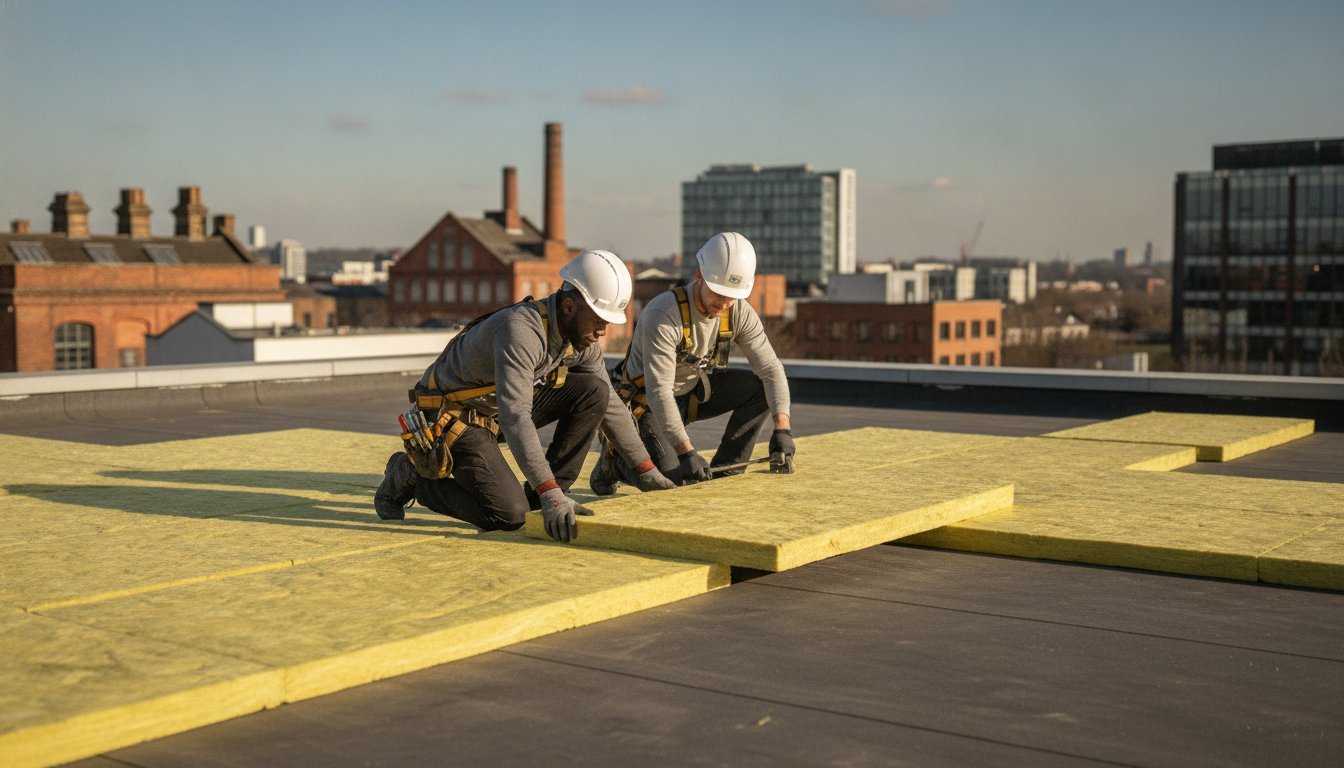
Did you know that an uninsulated roof can account for up to 25% of a commercial building’s total heat loss? For many warehouse owners in East London, this inefficiency isn’t just a minor oversight; it’s a direct drain on your annual profits. You’ve likely noticed the climbing costs of maintaining a stable temperature, or perhaps you’re already dealing with the persistent threat of condensation and damp affecting your valuable stock. We understand that the pressure to adapt to the 2026 Part L Building Regulations adds a layer of complexity to managing your facility. Investing in professional commercial roof insulation Hackney is the most effective way to regain control over your operational environment.
In this guide, we’ll explain how modern thermal upgrades can significantly reduce your overheads and ensure your asset is fully compliant with the latest 0.16 W/m²K U-value requirements for renovations. We’ll examine the practical differences between warm and cold roof systems, the longevity of high-performance PIR boards, and the specific steps required to future-proof your building against rising energy prices. This provides a clear roadmap for achieving industrial efficiency and long-term structural protection for your Hackney business.
Key Takeaways
- Understand how Hackney’s unique industrial heritage, from Victorian warehouses to steel-frame buildings, requires specific insulation strategies to prevent thermal bridging.
- Learn the technical differences between warm and cold roof systems to determine which configuration provides the best condensation control for your facility.
- Discover how high-performance materials like PIR boards and mineral wool can be used in commercial roof insulation Hackney projects to achieve superior thermal and acoustic results.
- Follow a methodical workflow to calculate target U-values and ensure your renovation meets the stringent Part L Building Regulations for 2026.
- Recognise the long-term financial benefits of insulation upgrades, including improved EPC ratings and the significant reduction of operational overheads.
Assessing Your Commercial Roof Insulation Needs in Hackney
Hackney’s architectural landscape is a unique blend of robust Victorian warehouses and mid-century industrial units. Whilst these buildings offer immense character for modern creative hubs, they often lack the fundamental Building insulation principles required for 21st-century efficiency. Many local business owners find themselves operating in uninsulated structures that bleed heat during the winter and become stifling during the summer months. This thermal instability is frequently exacerbated by East London’s urban microclimate. The density of the surrounding built environment traps heat at street level, yet large, exposed roof surfaces remain vulnerable to rapid temperature drops at night, creating a punishing cycle for your HVAC systems.
For those operating in industrial steel-frame buildings, the issue of thermal bridging is a primary concern. Steel is an excellent conductor of heat; without a continuous layer of commercial roof insulation Hackney businesses will see warmth literally wicked away through the structural beams. This doesn’t just increase your energy bills. It also creates cold spots on internal surfaces where moisture from the air can condense. Over time, this leads to persistent damp and mould, which can damage sensitive stock, electronic equipment, and the structural integrity of the roof deck itself. Identifying these signs early is vital to preventing long-term damage.
Heat Loss in Hackney Industrial Conversions
The trend of converting old factories into creative studios and open-plan offices has highlighted a major thermal challenge: high ceilings. In a typical Hackney conversion, the volume of air required to maintain a comfortable working temperature is vast. Without superior thermal performance, heat naturally rises and escapes through aging or damaged roof membranes. If your roof hasn’t been upgraded in the last decade, it’s likely that the original materials have degraded or shifted. We recommend conducting a professional thermal audit to identify exactly where your building’s envelope is failing. You can contact us to discuss how a condition survey can pinpoint these invisible energy leaks.
The Financial Impact of Poor Thermal Performance
Inefficient roofing isn’t just an environmental issue; it’s a financial burden that inflates operational overheads. When you calculate the cost of inaction over a standard five-year commercial lease, the figures are often startling. You’re essentially paying to heat the sky above East London. Beyond the immediate energy costs, poor insulation leads to long-term asset depreciation. Moisture ingress caused by condensation can rot timber joists or corrode metal decks, potentially leading to a full roof replacement sooner than expected. Ensuring your commercial roof insulation Hackney is up to modern standards protects your investment and improves the property’s overall market value.
Warm Roof vs Cold Roof: Choosing the Right Commercial System
When specifying commercial roof insulation Hackney projects, the most fundamental technical decision involves choosing between a warm roof and a cold roof configuration. This choice dictates how the building manages heat and moisture, ultimately impacting the longevity of the structural deck. In the context of Hackney’s diverse commercial stock, from Victorian brickwork to modern steel frames, selecting the wrong system can lead to significant maintenance issues within just a few years. Each approach has distinct merits depending on your building’s usage and any planning constraints related to roof height.
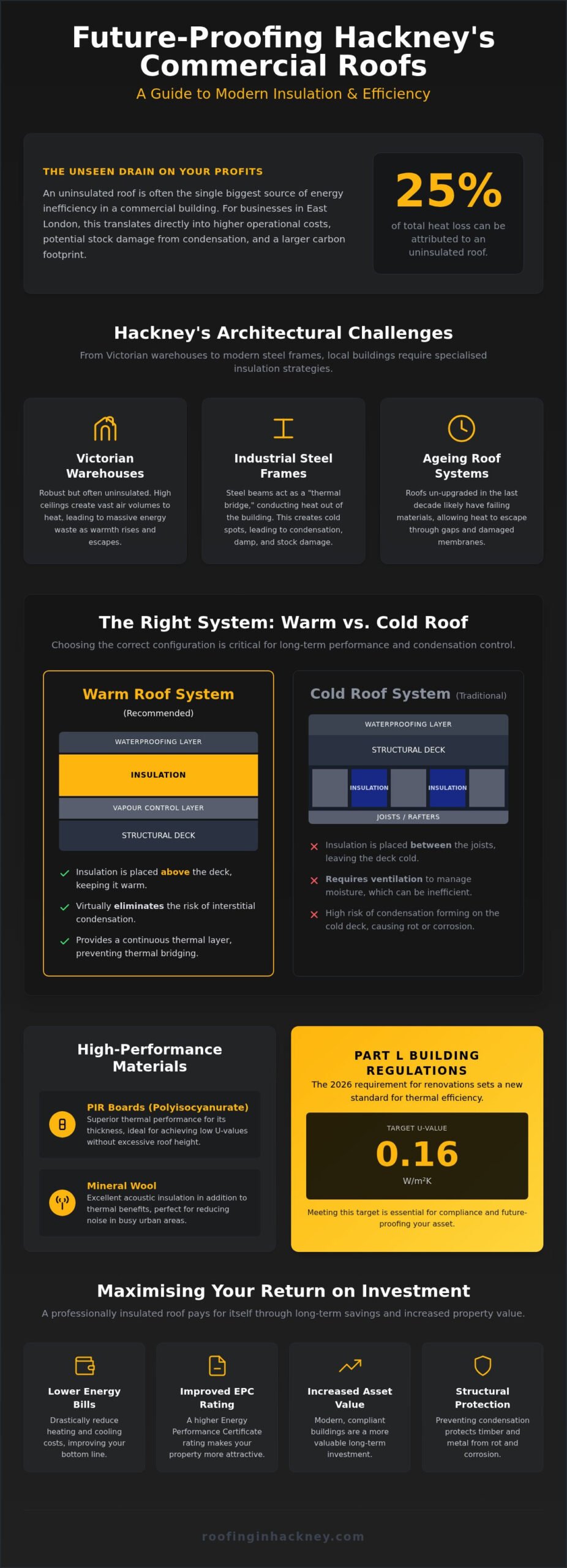
A warm roof construction involves placing the insulation layer entirely above the structural deck. This creates a “warm” structure, as the deck is kept at a temperature similar to the building’s interior. Conversely, a cold roof places the insulation between the rafters or joists, leaving the structural deck exposed to external temperatures. Whilst the cold roof was once the industry standard, modern energy requirements and the need for higher thermal performance mean that warm roofs are now the preferred choice for the majority of Hackney office and studio refurbishments.
Mechanics of the Warm Roof System
The primary advantage of a warm roof is its ability to eliminate the risk of interstitial condensation. By placing the insulation on the outside of the structure, the dew point is moved external to the roof deck. This prevents moisture from the building’s interior from condensing within the roof’s fabric, which is a common cause of timber rot and metal corrosion. This system is highly compatible with modern high-performance membranes such as EPDM or Single-Ply. For large, open-plan Hackney floorplates, this creates a continuous thermal envelope that is essential for complying with Approved Document L regulations.
When to Utilise Cold Roof Insulation
There are specific scenarios where a cold roof approach remains necessary, particularly in Hackney’s 35 conservation areas. If planning restrictions prevent any increase in the external height of the building, insulating between the rafters may be the only viable option. However, this method requires meticulous attention to detail. Effective cross-ventilation is mandatory, typically requiring a 50mm air gap above the insulation to allow moisture to escape. Without this, the risk of structural failure due to trapped dampness is high. If you are managing a heritage asset and are concerned about meeting modern standards, you can request a technical consultation to explore your options.
Ultimately, the decision often balances internal ceiling height against external building height. A warm roof preserves the aesthetic of exposed internal beams, which is a popular feature in Hackney’s creative sectors, but it does raise the overall roofline. We work closely with landlords to ensure that the chosen commercial roof insulation Hackney system provides the best possible ROI while respecting the architectural integrity of the premises.
High-Performance Materials for Hackney Commercial Roofs
Selecting the correct commercial roof insulation Hackney requires a balance between thermal efficiency, fire safety, and structural constraints. Whilst the system choice provides the framework, the material choice determines the long-term performance of the building. In Hackney’s dense urban environment, where mixed-use buildings are common, your choice of insulation must also account for acoustic dampening and stringent fire regulations. A vital component often overlooked is the Vapour Control Layer (VCL). For Hackney flat roofs, the VCL is the first line of defence. It sits beneath the insulation to prevent internal water vapour from condensing within the roof structure. Without a robust VCL, even the most expensive insulation will eventually lose its effectiveness as it absorbs moisture.
Rigid Insulation Boards and PIR
PIR (Polyisocyanurate) rigid boards are the standard for modern commercial installations. Their primary advantage is their exceptional thermal conductivity, which allows for a slim profile. Achieving the target U-value of 0.16 W/m²K often requires significantly less thickness with PIR compared to traditional glass fibre. This is particularly beneficial for Hackney refurbishments where maintaining a low roof profile is necessary to avoid planning complications or to preserve the building’s original aesthetic. Beyond thermal performance, PIR boards offer high compressive strength. This is essential for commercial roofs that host plant machinery, such as air conditioning units, or require regular foot traffic for maintenance. The boards provide a stable, durable platform that won’t deform under load, ensuring the waterproof membrane remains intact for its full service life.
Sustainable and Acoustic Insulation Options
For businesses located near Hackney High Street or under busy flight paths, noise reduction is a priority. Mineral wool is the superior choice for acoustic insulation. Its dense, fibrous structure absorbs sound waves, creating a much quieter internal environment for offices and creative studios. Additionally, mineral wool is naturally non-combustible. This provides an extra layer of fire protection that is often a requirement for commercial insurance compliance and building safety standards. Integrating these materials into a broader thermal roof insulation upgrade allows Hackney property owners to meet sustainability goals. Many mineral wool products are manufactured from recycled glass or volcanic rock, offering a lower carbon footprint than purely synthetic alternatives. We help you navigate these material choices to ensure your roof is safe, quiet, and thermally efficient.
How to Plan Your Commercial Insulation Upgrade: A Step-by-Step Workflow
Planning a commercial roof insulation Hackney project requires a methodical approach to ensure both legal compliance and operational continuity. It isn’t merely a case of laying down new boards. You need a structured workflow that accounts for the unique structural characteristics of East London’s building stock and the stringent 2026 Building Regulations. By following a clear sequence, you can avoid the common pitfalls of budget overruns and technical failures whilst ensuring your facility remains protected throughout the process.
The Professional Site Survey
The first stage of any successful upgrade is a comprehensive condition survey. For older Hackney warehouses, we don’t rely on visual inspections alone. Our team utilises moisture probes and core sampling to determine if moisture is trapped within the existing substrate. If your current roof has been leaking, the structural deck might be compromised by rot or corrosion. It’s also vital to assess the weight-bearing capacity of your building. Modern insulation standards often require thicker layers to achieve the mandatory 0.16 W/m²K U-value, and your structure must be capable of supporting this additional load without risk.
Once the technical data is gathered, the focus shifts to system selection. As discussed, whilst warm roofs are generally superior for efficiency, heritage constraints in certain parts of Hackney might dictate a cold roof approach. We help you calculate the target U-values and select high-performance materials that balance thermal gain with your building’s specific architectural profile.
Managing the Installation Phase
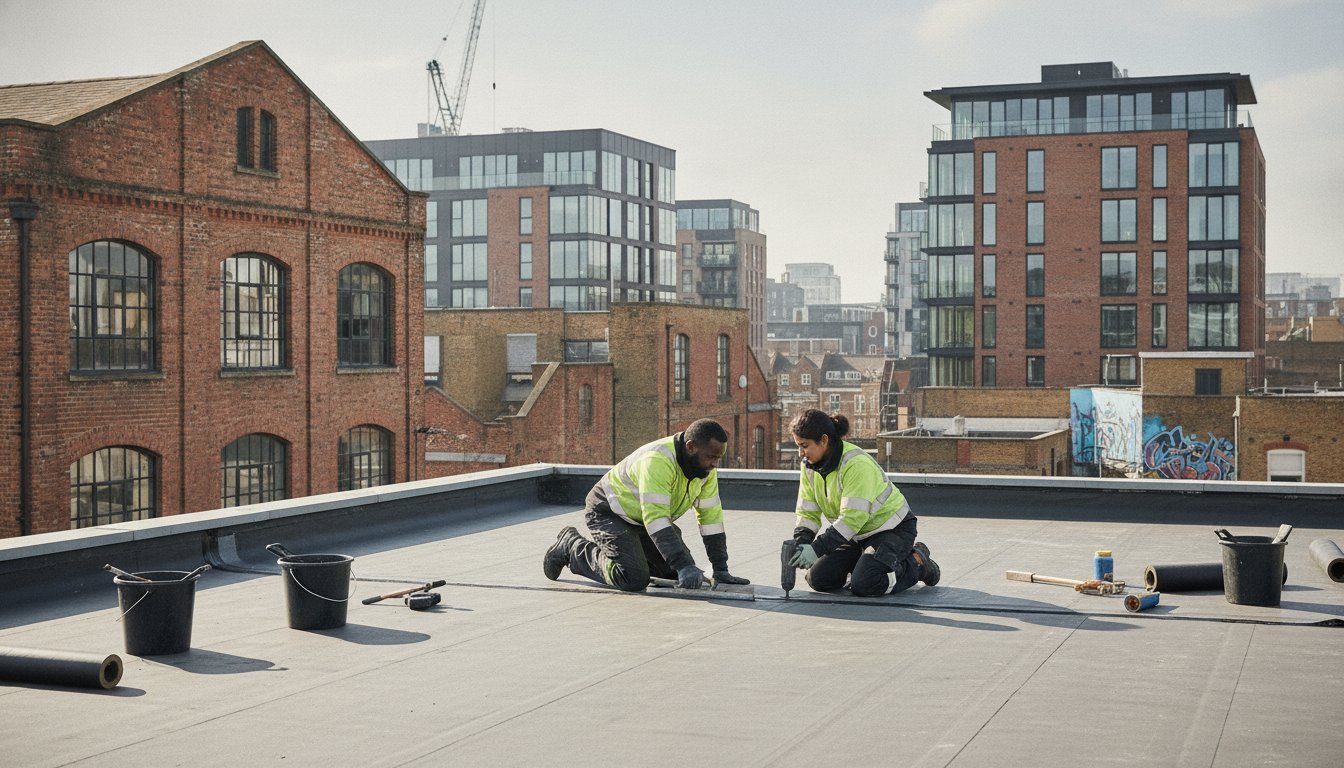
Execution in a high-density urban area like Hackney presents significant logistical challenges. Roofing in Hackney specialises in managing these complexities, from coordinating material deliveries on narrow streets to implementing robust Health and Safety protocols. We recognise that your business needs to remain operational. Our teams work in phases, ensuring that only small sections of the roof are “open” at any given time. This methodical approach protects your internal assets, such as stock and machinery, from the unpredictable British weather.
The final stage involves a rigorous inspection to ensure the installation meets all design specifications. We provide the necessary certification for insurance purposes and to prove compliance with Part L regulations. This documentation is essential for maintaining your property’s value and ensuring you’re fully covered in the event of a claim. If you’re ready to begin this process, you can book a professional roof condition survey to identify your building’s specific needs.
Maximising ROI: Regulation Compliance and Building Value
Moving from reactive maintenance to a proactive strategy is the hallmark of effective property management in East London. Historically, many landlords viewed roofing work as a “distress purchase” triggered only by visible leaks. However, high-performance commercial roof insulation Hackney should be viewed as a strategic capital improvement. By integrating insulation into reliable commercial roofing projects, you effectively reset the building’s lifecycle. This holistic approach ensures that the structural waterproof layer and the thermal envelope work in perfect synergy, providing a much higher return on investment than isolated, temporary repairs.
Building Regulations Part L (2026)
The legal landscape for commercial refurbishments has become significantly more stringent with the 2026 updates to Part L. If you’re replacing or renovating more than 50% of your roof’s surface area, the law mandates that you must upgrade the thermal performance to meet current U-value targets. This threshold is often lower than property owners realise, and failing to comply can lead to enforcement notices from Hackney Council. For commercial landlords, the documentation provided by a specialist is crucial. We provide the technical evidence required to prove compliance, protecting you from the legal and financial risks associated with non-compliant “bodge” jobs that fail to meet modern energy standards.
Securing Your Property’s Future
In Hackney’s competitive commercial market, tenants are increasingly prioritising energy-efficient spaces to manage their own rising overheads. A high-performance roof upgrade can contribute between 10 and 15 points to your building’s Energy Performance Certificate (EPC) rating. This improvement doesn’t just lower utility bills. It makes your property more attractive to higher-quality tenants who value sustainability and operational stability. A building that is cheap to heat and cool is a building that stays occupied.
Reducing the carbon footprint of your East London operations is no longer optional for many businesses; it’s a core part of their corporate responsibility. Investing in commercial roof insulation Hackney ensures your asset remains relevant and valuable in a rapidly evolving market. You can contact our team today for a bespoke commercial insulation quote to begin future-proofing your investment and enhancing your property’s market position.
Future-Proof Your Hackney Commercial Asset
Securing the long-term viability of your commercial premises requires a move away from temporary fixes toward strategic structural improvements. We’ve explored how a robust thermal strategy reduces overheads, prevents damp, and ensures your building meets modern efficiency standards. Whether you’re managing a creative studio conversion or a large industrial warehouse, the choice of materials and systems will dictate your operational costs for decades to come.
Investing in professional commercial roof insulation Hackney is the most reliable way to secure your building’s thermal performance and market value. As specialists in Hackney warehouse and industrial conversions, we ensure every project is fully compliant with 2026 Part L Building Regulations. Our expertise spans both flat and pitched commercial systems, allowing us to deliver precise results tailored to East London’s unique architectural heritage.
Taking a proactive approach today protects your assets and provides a comfortable, high-performance environment for your tenants. Request a Commercial Insulation Survey from Roofing in Hackney to begin your journey toward industrial efficiency. We look forward to helping you future-proof your investment with confidence.
Frequently Asked Questions
How much can I save on energy bills with commercial roof insulation in Hackney?
You can typically reduce your building’s heat loss by up to 25% by installing high-performance commercial roof insulation Hackney. Whilst exact savings depend on your facility’s volume and current HVAC usage, many local businesses report a significant reduction in annual operational overheads. Improving thermal efficiency also helps stabilise internal temperatures during the summer, reducing cooling costs. This contributes to a reliable payback period, which industry data often estimates between five and eight years.
Do I need to replace my entire commercial roof to upgrade the insulation?
Not necessarily, but it depends on the condition of your existing waterproof membrane and structural deck. If you’re renovating more than 25% of the roof area, current building regulations mandate a thermal upgrade. We can often install a warm roof system over a sound, dry deck. However, if our survey identifies trapped moisture or structural rot, a full replacement is usually the only way to ensure the long-term integrity of your thermal layers.
What are the current U-value requirements for Hackney commercial buildings in 2026?
For commercial refurbishments and renovations in 2026, the maximum target U-value is typically 0.16 W/m²K. If you’re involved in a new build project, the standards are even more stringent, often requiring a value of 0.11 W/m²K. These requirements are part of the updated Approved Document L regulations. Meeting these targets ensures your property remains legally compliant and achieves a higher EPC rating, which is vital for attracting quality tenants and maintaining asset value.
How long does a typical commercial roof insulation project take to complete?
A standard project for a medium-sized Hackney warehouse usually takes between one and three weeks to complete. The timeline varies based on the roof’s complexity, the chosen insulation system, and the prevailing weather conditions. We work in phases to ensure your business remains operational, keeping the building weather-tight throughout the process. A detailed schedule is always provided following a site survey to help you plan your logistics and minimise any internal disruption.
Is warm roof insulation better than cold roof insulation for warehouses?
Warm roof insulation is generally the superior choice for large open-plan warehouses. By placing the insulation above the structural deck, you eliminate cold spots and move the dew point outside the building’s fabric. This effectively prevents interstitial condensation, which is a major cause of structural decay in steel-frame buildings. Whilst cold roofs are used in specific heritage contexts, warm roofs provide a continuous thermal envelope that is much more efficient for maintaining stable industrial temperatures.
Will commercial roof insulation help with noise reduction from Hackney traffic?
Yes, choosing the right material can significantly dampen external noise pollution. Whilst PIR boards are excellent for thermal performance, mineral wool is the preferred option for acoustic insulation. Its dense, fibrous structure is highly effective at absorbing sound waves from busy Hackney High Streets or nearby railway lines. If your commercial premises are being used as creative studios or offices, combining thermal and acoustic layers provides a much more productive and quiet internal working environment.
Can I get a grant for commercial roof insulation in East London?
Direct grants for commercial insulation can be limited, but various tax incentives and green finance options are often available for energy-efficiency projects. Some businesses may qualify for capital allowances on energy-saving plant and machinery upgrades. It’s advisable to consult with a financial advisor or check the latest Hackney Council business support pages for regional schemes. Even without a direct grant, the long-term reduction in energy bills and improved asset value often provide a compelling ROI.
How do I know if my current commercial roof insulation has failed?
Visible signs of failure include persistent condensation on the underside of the roof deck or the presence of mould on internal ceilings. You might also notice that your heating systems are running constantly without reaching the desired temperature. In older industrial buildings, thermal bridging often causes specific cold spots that are damp to the touch. If you observe these issues, a professional thermal audit is recommended to identify if the insulation has become saturated or degraded.