A failing flat roof is no longer just a maintenance headache; in 2026, it’s a direct threat to your property’s legal compliance and commercial viability. Most Hackney business owners are exhausted by the cycle of expensive patch repairs that fail to address underlying structural issues or the spiralling energy costs caused by outdated insulation. You likely recognise that your current roof is becoming a liability, yet the fear of operational downtime and shifting building regulations often stalls necessary action.
This strategic guide to commercial flat roof replacement Hackney provides the clarity needed to transition from reactive fixes to a high-performance asset. We’ll show you how to secure a leak-free, 25-year durable solution that aligns with the latest MEES requirements and Part L thermal standards. By following this professional roadmap, you’ll understand how to integrate modern materials and solar-ready technology whilst ensuring your installation is handled with the precision and local expertise your Hackney premises deserve. We’ll preview the essential steps to achieve a compliant, energy-efficient finish that protects your investment for the long term.
Key Takeaways
- Understand how Hackney’s urban density impacts project logistics, from navigating local scaffolding permits to coordinating material deliveries in restricted commercial zones.
- Evaluate high-performance membranes and liquid-applied systems to select a durable, fire-safe solution tailored to your building’s unique architectural footprint.
- Apply our strategic ROI framework to identify exactly when a full commercial flat roof replacement Hackney becomes a more cost-effective investment than ongoing patch repairs.
- Ensure your project meets 2026 MEES requirements and Building Regulations Part L by integrating advanced thermal insulation upgrades into your replacement strategy.
- Discover how bespoke specifications and master craftsman standards can protect your commercial asset from environmental stressors whilst increasing its overall market value.
The Challenges of Commercial Flat Roof Replacement in Hackney
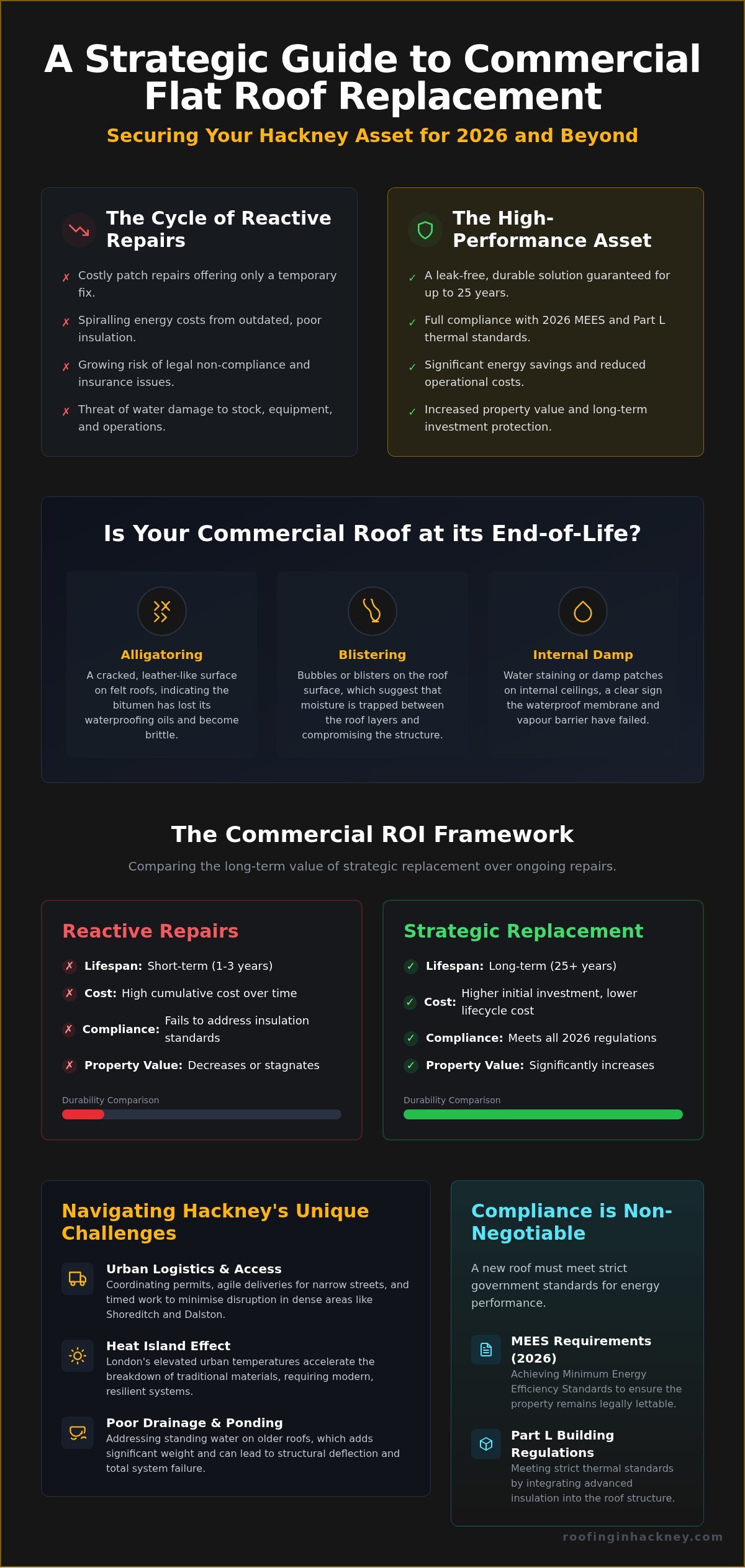
Hackney’s commercial landscape is a dense tapestry of Victorian warehouses, mid-century industrial blocks, and modern retail units. This architectural diversity means that a commercial flat roof replacement Hackney isn’t a standard procedure. It requires a nuanced understanding of how East London’s specific environment degrades structural integrity. The London “heat island” effect accelerates the breakdown of traditional bituminous materials, causing them to become brittle and crack under thermal stress. When combined with the increasing frequency of heavy rainfall, these micro-fissures allow water to penetrate the building envelope, risking expensive equipment and commercial stock.
Many older properties in the borough still rely on outdated specifications that weren’t designed for modern climate patterns. Whilst modern flat roofing systems offer superior resilience and thermal performance, many existing structures suffer from poor drainage. This leads to “ponding,” where standing water sits on the roof surface for more than 48 hours. The sheer weight of this water can cause structural deflection, further exacerbating the problem and leading to a total system failure if left unaddressed. Proactive replacement is often the only way to safeguard the building’s core assets.
Signs Your Commercial Flat Roof Has Reached End-of-Life
Identifying failure early is critical for business continuity. You should look for “alligatoring” on traditional felt roofs, where the surface resembles cracked leather. This indicates the bitumen has lost its essential oils and can no longer provide a waterproof seal. Blistering is another common sign, suggesting that moisture is trapped within the roof layers. Internal dampness or water staining on ceilings often signals that the vapour barrier is compromised. Ignoring these signs can lead to significant increases in commercial insurance premiums, as insurers often cite “lack of maintenance” to decline claims related to water damage.
Hackney Logistics: Access, Permits, and Planning
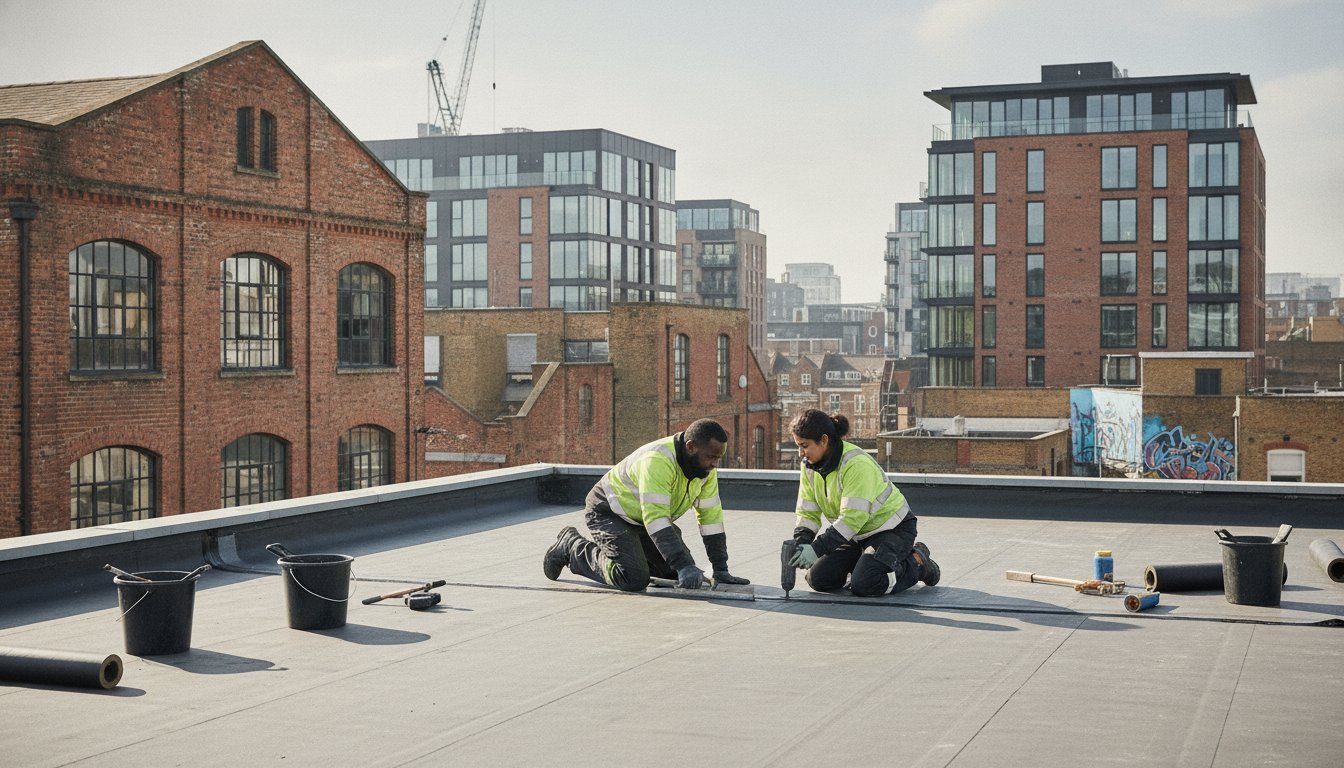
Executing a project in areas like Dalston, Shoreditch, or Hackney Central presents significant logistical hurdles. Narrow access routes and high footfall often make standard waste removal and material delivery impossible without expert coordination. We manage these complexities through a methodical approach to urban roofing:
- Permit Management: We coordinate with Hackney Council to secure scaffolding permits, ensuring compliance whilst minimising disruption to public footways.
- Access Solutions: Using smaller, agile delivery vehicles allows us to navigate narrow East London streets where large lorries cannot pass.
- Operational Timing: We schedule the most disruptive phases of the work to avoid peak business hours, protecting the customer experience for local retailers and cafes.
Managing these urban constraints is as vital to the project’s success as the technical installation itself. If you’re concerned about how logistics might affect your premises, you can contact us to discuss a site-specific access plan.
Modern Flat Roofing Systems for Hackney Businesses
Selecting the right specification for a commercial flat roof replacement Hackney requires a balance between initial investment and long-term operational resilience. The shift from traditional bituminous felt towards high-performance membranes has been driven by the need for greater durability and stricter fire safety standards. For Hackney’s diverse commercial stock, from Shoreditch creative studios to Homerton industrial units, the choice of material must account for mechanical plant, regular maintenance traffic, and the specific structural loading of the building.
Modern systems are engineered to withstand the unique pressures of the urban environment. Whether your priority is fire resistance, ease of maintenance, or the ability to support future solar installations, the current generation of roofing technologies provides a solution that far exceeds the performance of materials used just a decade ago. We focus on systems that offer proven longevity and clear compliance with the latest safety classifications.
High-Performance EPDM and Single-Ply Membranes
EPDM (Ethylene Propylene Diene Monomer) and single-ply membranes have become the industry standard for large-scale offices and warehouses across East London. These materials offer exceptional UV resistance, which is vital for buildings exposed to significant solar gain. Because these membranes remain flexible in extreme temperatures, they don’t crack or split during the rapid thermal cycling common in the capital.
A primary benefit of single-ply systems is their life expectancy, which often exceeds 30 years with minimal maintenance. These systems are lightweight, reducing the structural load on older Hackney buildings. When installed correctly, they meet the EN 13501-5 BROOF(t4) fire classification. This ensures your property complies with the Building Safety Act requirements for higher-risk buildings, providing peace of mind for both owners and tenants.
Liquid-Applied Waterproofing for Complex Structures
For Hackney properties with intricate roof footprints or significant amounts of plant equipment, such as HVAC units and ventilation ducting, liquid-applied systems are often the superior choice. These systems are applied as a cold liquid that cures into a seamless, elastomeric membrane. This seamless quality is crucial because it eliminates the joints and seams where most flat roof failures typically occur.
The cold-applied nature of these systems is a significant advantage for active commercial sites. It removes the need for gas torches or hot-works, drastically reducing the fire risk during the installation process. Liquid systems bond directly to almost any substrate, making them ideal for complex refurbishments where multiple penetrations exist. If you are unsure which system suits your building’s specific footprint, you can request a technical assessment to explore the most durable options for your premises. This methodical selection process ensures your new roof is a high-performance asset designed for the next quarter-century.
Repair vs. Replacement: The Commercial ROI Framework
For many property managers in East London, the decision between a quick patch and a full commercial flat roof replacement Hackney often comes down to immediate budget constraints. However; viewing roofing solely as a reactive expense is a common strategic error. Repeatedly investing in localised repairs on a failing substrate creates a “false economy” where the cumulative cost of call-outs, internal damage remediation, and lost productivity quickly exceeds the price of a comprehensive installation.
A full replacement transforms a liability into a high-performance asset. It provides the structural certainty required for long-term leases and can significantly enhance the market value of commercial units in competitive areas like Hackney Wick or London Fields. By transitioning from a cycle of emergency fixes to a 25-year guaranteed system, businesses can shift their focus from crisis management to planned capital expenditure. This long-term view is essential for protecting the building’s core fabric and the sensitive equipment housed within.
Calculating the Long-Term Value of Replacement
The ROI of a new roof extends beyond simple water ingress prevention. A modern, certified system reduces operational downtime, ensuring that staff and equipment remain protected during London’s increasingly volatile weather events. This reliability is often a prerequisite for maintaining comprehensive building insurance and securing favourable terms during property refinancing. When Choosing Local Roofing Specialists for Major Projects, you ensure the technical specifications meet the rigorous demands of urban commercial use whilst satisfying the expectations of surveyors and stakeholders.
Minimising Business Disruption During Works
We understand that closing your doors for a roof replacement is rarely an option for local retailers or office-based firms. Our methodology prioritises methodical project phasing, allowing your business to remain fully operational whilst works are underway. We achieve this through several key strategies:
- Zone-Based Installation: Completing the roof in manageable sections to limit the active site area at any given time.
- Noise and Dust Mitigation: Utilising specialised extraction equipment and scheduling high-impact tasks outside of core office hours to maintain a professional environment.
- Tenant Communication: Implementing clear protocols to keep building occupiers informed of progress, ensuring everyone knows what to expect and when.
This organized approach ensures that the transition to a high-performance roofing system is seamless. It protects your immediate revenue streams whilst securing the building’s future against the rising costs of reactive maintenance.
Compliance, Building Regulations, and Thermal Upgrades
A commercial flat roof replacement Hackney is more than a structural necessity; it’s a legal trigger for mandatory energy efficiency improvements. Under the 2024 updates to Building Regulations Part L, any refurbishment covering more than 25% of a roof’s surface area requires the entire thermal element to be upgraded to current standards. For commercial property owners, this means achieving a target U-value of 0.16 W/m²K. These regulations are designed to align with the 2026 MEES (Minimum Energy Efficiency Standards) requirements, which mandate stricter EPC ratings for non-domestic buildings to remain legally lettable.
Most Hackney businesses opt for a “warm roof” configuration during replacement. In this setup, high-performance insulation is installed above the structural deck but beneath the waterproof membrane. This creates a thermally efficient building envelope that eliminates cold bridging and protects the roof structure from temperature fluctuations. By modernising the insulation layer, you don’t just comply with the law; you significantly reduce the carbon footprint and operational utility costs of your premises.
Thermal Performance and Energy Efficiency
Investing in superior insulation is one of the few roofing costs that provides a direct financial return. By reducing heat loss through the roof, modern systems allow for smaller, more efficient HVAC systems and lower monthly energy bills. These upgrades often pay for themselves within a few years, especially given the volatile energy prices facing East London businesses. For a deeper look at specific material choices, see our Thermal Roof Insulation Upgrades: Energy Efficiency Guide. We ensure that every specification is tailored to Hackney’s diverse commercial stock, from high-street retail to light industrial units.
Building Control and Certification
Compliance requires a methodical approach to documentation. For any notifiable roofing project, we manage the Building Control notification process to ensure your work is officially recognised and certified. The Building Safety Act now mandates timestamped photographic evidence of the insulation installation and the integrity of the vapour barrier. This level of transparency is vital for several reasons:
- Property Transactions: A Building Regulations Compliance Certificate (BRCC) is essential for any future sale or lease of the commercial asset.
- Insurance Validity: Insurers increasingly require proof of regulatory compliance to maintain valid coverage for structural elements.
- Fire Safety: We ensure all materials meet EN 13501-5 BROOF(t4) fire classifications, a critical requirement for higher-risk buildings over 18 metres.
Securing these certifications protects your investment and ensures your building remains a compliant, valuable asset. If you need to verify your current roof’s compliance status, you can book a professional regulatory audit with our technical team.
The Roofing in Hackney Approach to Commercial Excellence
Our approach to commercial flat roof replacement Hackney is rooted in the “Master Craftsman” tradition, where technical proficiency meets deep local understanding. Hackney’s commercial buildings aren’t generic structures; they’re historical and economic assets that require specific structural interventions. We don’t just apply a standard membrane. Instead, we design a bespoke roofing solution that accounts for the building’s age, its current use, and the specific urban stressors of East London. This methodical focus on craftsmanship ensures that every installation is not just a repair, but a permanent upgrade to the building’s commercial value.
Local expertise is indispensable for projects of this scale. Understanding the nuances of Hackney’s architectural styles allows us to anticipate structural challenges before they become costly delays. Whether we’re working on the heavy timber decks of Shoreditch warehouses or the concrete slabs of mid-century industrial blocks, our familiarity with local building stock is a significant advantage. This regional knowledge, combined with our commitment to modern standards, provides property managers with the calm dependability they need when overseeing significant capital investments.
Bespoke Project Management for Hackney Businesses
Our workflow is designed for transparency and predictability. It begins with a comprehensive technical survey that identifies the root cause of existing failures, followed by a detailed specification tailored to your building’s footprint. We prioritise high-quality materials, such as reinforced membranes and high-density insulation, to provide maximum weather protection. Throughout the process, our project managers provide regular updates, ensuring you’re informed from the initial site setup to the final sign-off. You can learn more About Our Local Professional Team and our commitment to technical excellence.
Securing Your Commercial Asset for the Future
A roof replacement is a 25-year investment, and its longevity depends on more than just the initial installation. We provide comprehensive guarantees and develop bespoke maintenance plans to help property managers protect their assets. This proactive aftercare includes scheduled inspections to clear drainage systems and check for any mechanical damage from third-party plant contractors. Having a trusted local partner in East London means help is always nearby if you need a professional consultation or a minor adjustment. By choosing a specialist who is invested in the Hackney community, you ensure your property remains a secure, high-performing asset for decades to come. Contact our Hackney commercial team for a professional survey to begin your property’s transition to a high-performance roofing system.
Securing Your Hackney Commercial Asset for the Long Term
Navigating a commercial flat roof replacement Hackney requires more than just technical skill; it demands a partner who understands the logistical and regulatory landscape of East London. By moving away from the cycle of recurring patch repairs and investing in a high-performance system, you secure your building’s structural integrity whilst significantly reducing operational energy costs. Meeting the 2026 Building Regulations is no longer optional for local business owners, but a strategic opportunity to modernise their property assets.
As specialists in large-scale commercial projects, we combine traditional craftsmanship with the latest thermal technologies. Our installations are fully compliant with current standards and backed by 25+ year guarantees, providing the long-term security your business deserves. We pride ourselves on delivering results that stand up to the unique environmental pressures of the borough. Don’t let an ageing roof compromise your commercial stock or equipment.
Request a Professional Commercial Roof Survey in Hackney to discuss your specific requirements with our technical team. We look forward to helping you protect your investment with a durable, compliant, and energy-efficient solution.
Frequently Asked Questions
Do I need planning permission for a commercial flat roof replacement in Hackney?
Most commercial flat roof replacement Hackney projects fall under “permitted development” and don’t require full planning permission. However, you must notify Hackney Council if the building is listed or located within a conservation area. Regardless of planning, Building Regulations notification is mandatory for any replacement involving structural elements or insulation. We handle the technical documentation to ensure your project remains fully compliant with local authority standards.
How long does a typical commercial flat roof replacement take to complete?
The duration of a project depends entirely on the roof’s scale and complexity. A standard 50-square-metre commercial unit typically takes three to five working days to complete. Larger industrial blocks or warehouse units may require two weeks or more. We account for Hackney-specific logistical factors, such as scaffolding permit lead times and narrow-street access, during the initial planning phase to ensure a predictable and efficient timeline.
Can you replace a commercial roof whilst the building is still occupied?
Yes, we specialise in replacing commercial roofs whilst the building remains fully operational. We utilise methodical project phasing and noise-mitigation strategies to ensure your staff and tenants are not disturbed. By selecting cold-applied liquid systems, we also eliminate the fire risks and odours associated with traditional hot-works. This approach allows local retailers and offices to maintain their daily business activities without the need for expensive temporary relocation.
What are the current Building Regulations for commercial roof insulation in 2026?
As of 2026, Building Regulations Part L mandates that commercial roof refurbishments must achieve a U-value of 0.16 W/m²K if you are replacing more than 25% of the area. This regulation is a key component of meeting the latest MEES requirements for non-domestic properties. We incorporate high-density insulation upgrades into every specification to ensure your building envelope meets these strict thermal standards and reduces long-term carbon emissions.
Which flat roofing material is most durable for a Hackney commercial property?
EPDM rubber and high-performance single-ply membranes are amongst the most durable options for Hackney’s commercial buildings. These materials offer exceptional UV resistance and remain flexible despite London’s temperature fluctuations. For roofs with complex plant equipment or multiple penetrations, a liquid-applied system is often superior as it creates a seamless, reinforced waterproof barrier. Each material is selected based on its ability to provide a 25-year plus service life with minimal maintenance.
What is the difference between a warm roof and a cold roof for businesses?
A warm roof places the insulation layer above the structural deck, keeping the entire building fabric at a consistent temperature. This is the preferred configuration for commercial assets because it prevents condensation and maximises thermal efficiency. In contrast, a cold roof has insulation between the joists, leaving the deck exposed to external temperature changes. Warm roofs are generally more effective at meeting modern energy standards and protecting the building’s structural integrity.
How much disruption should I expect during the scaffolding phase in Hackney?
We minimise disruption by coordinating closely with Hackney Council regarding scaffolding permits and pavement licences. On busy high streets, we often use narrow-profile scaffolding to maintain pedestrian flow and ensure shopfront visibility. Our team manages the entire process, including waste removal in restricted urban zones. We schedule the most intensive logistical phases to avoid peak business hours, ensuring your customers and clients can access your premises safely and easily.
Do modern commercial flat roofs come with a long-term guarantee?
Yes, our commercial installations typically come with comprehensive 20 to 25-year guarantees covering both materials and workmanship. These warranties are essential for protecting your capital investment and are often required by insurers and mortgage lenders. Because we use industry-certified systems and master craftsman techniques, these guarantees provide long-term peace of mind. We also offer bespoke aftercare plans to ensure your new roof continues to perform optimally throughout its entire lifespan.