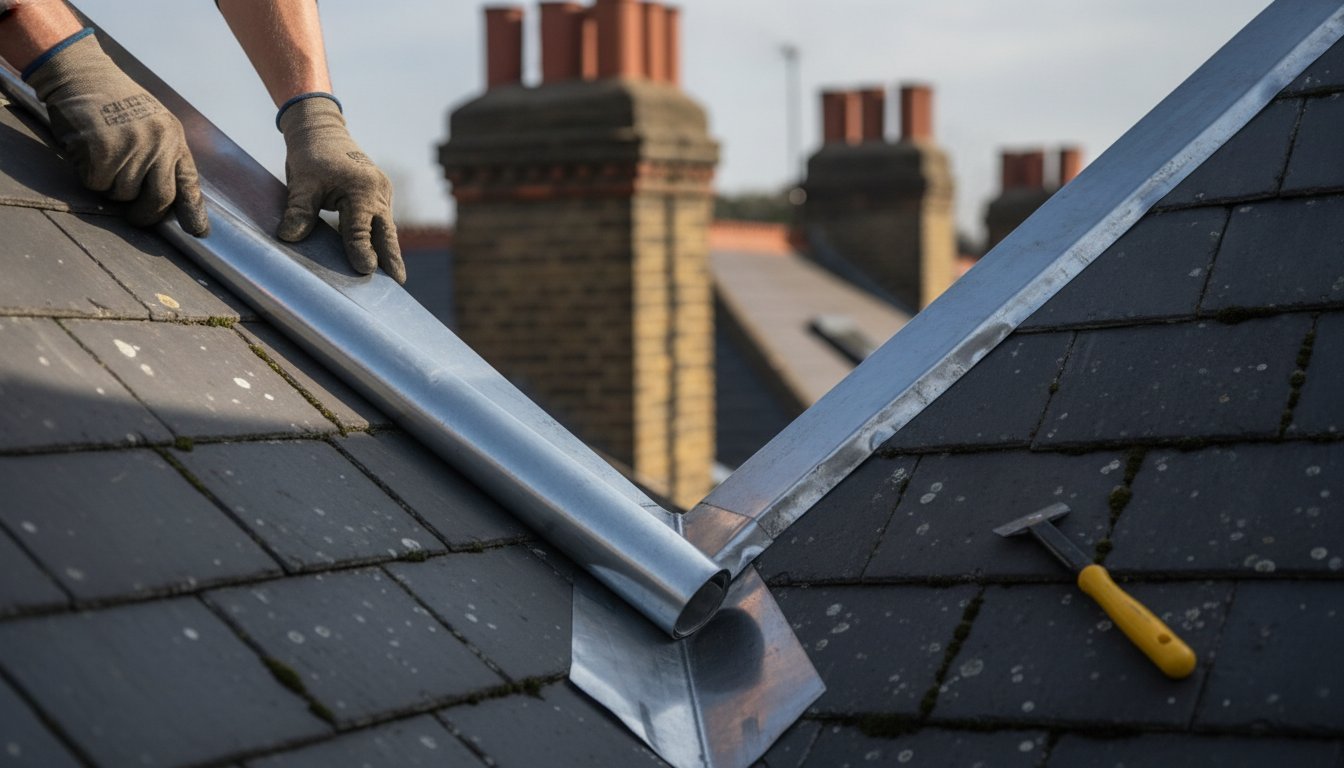
A single compromised roof valley can cause more structural damage to a Hackney terrace than a decade of heavy London rain on its slates. When you require a roof valley repair Hackney specialists are essential because these internal gutters are the most vulnerable points of your home’s defence against the elements. It’s common for homeowners to feel a sense of dread when a damp patch appears on a Victorian ceiling, particularly when you consider the potential for rot to take hold of the underlying timber or damage irreplaceable period features.
We understand that you need more than just a quick fix; you need a solution that respects the heritage of your property whilst providing absolute security. This guide will show you how to identify the early warning signs of failure and why professional leadwork is the superior choice for long-term protection. We’ll outline our methodical approach to leak prevention, from the initial assessment to the final installation of durable materials. By the end, you’ll have a clear understanding of the repair process and the confidence to secure a watertight future for your home with fixed-price reliability from a master craftsman who knows East London’s unique architecture.
Key Takeaways
- Understand why the V-shaped junction is the most vulnerable part of your roof and how it directs water away from your home’s structure.
- Learn to identify common signs of lead fatigue and mortar erosion that necessitate a professional roof valley repair Hackney service before internal damage occurs.
- Compare the long-term benefits of traditional leadwork against modern GRP alternatives to determine the best material for your property’s heritage and budget.
- Discover what to expect during a professional restoration, from high-level inspections to the vital role of safe scaffolding access.
- Gain insight into why maintaining traditional craftsmanship is essential for preserving the structural integrity and aesthetic value of Hackney’s period properties.
Why Roof Valleys are Critical for Your Hackney Home
A roof valley is the internal V-shaped junction formed where two pitched roof slopes meet at an angle. This component acts as the primary drainage channel for your property, collecting vast volumes of rainwater and directing it safely into the guttering system. Because valleys handle more water than any other part of the roof surface, they are often the first point of failure in East London’s dense urban environment. When homeowners require a professional roof valley repair Hackney properties often present unique challenges due to their age and construction style. In Hackney’s historic terraces, you’ll typically encounter valleys lined with traditional lead, whilst older mortar-bedded versions or modern GRP (Glass Reinforced Plastic) alternatives are also present.
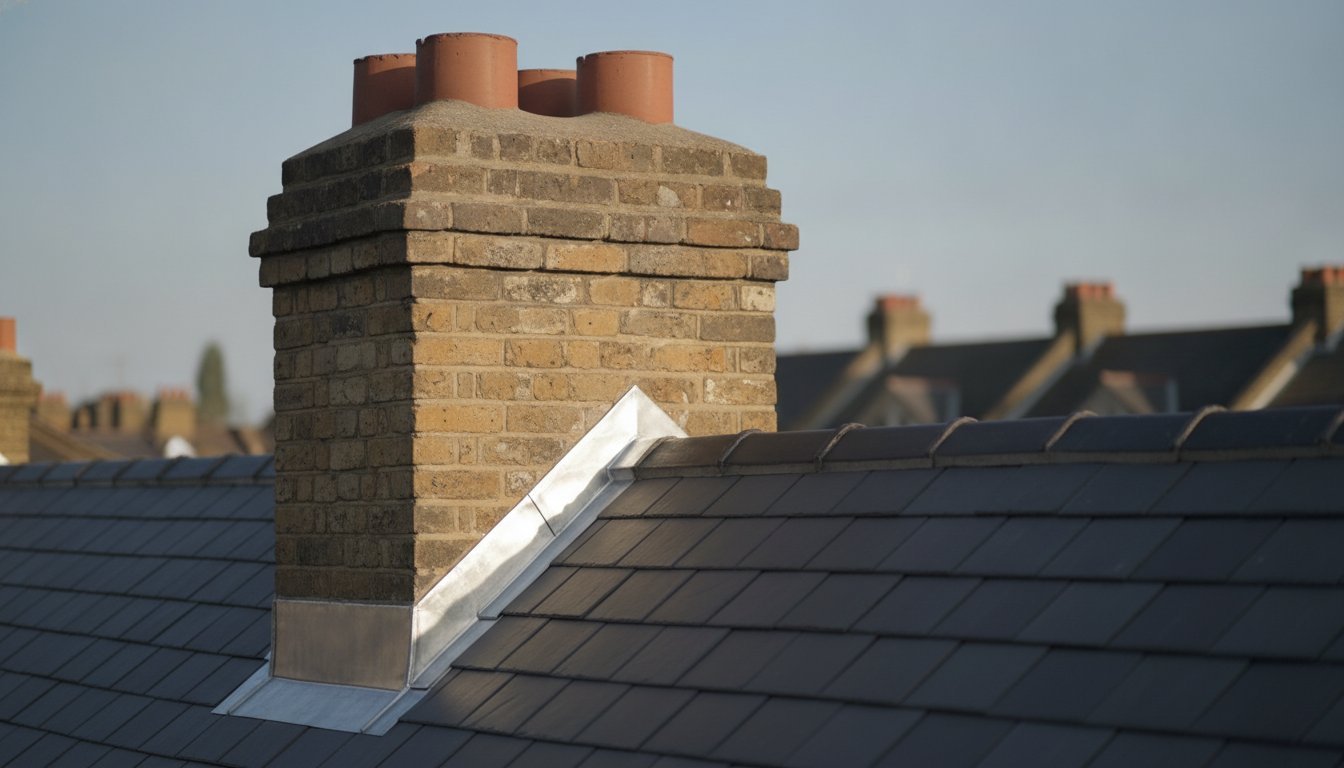
The valley lining functions as a critical form of Flashing (weatherproofing), creating an impermeable barrier between the structural timber and the elements. Without this protective layer, water would seep directly into the roof void, causing rapid deterioration. It’s a technical area where precision is non-negotiable to ensure the long-term integrity of the building.
The Anatomy of a High-Performance Roof Valley
Beneath the visible waterproof lining lies a system of timber valley boards that provide the necessary structural support. A correctly installed valley also requires a tilt fillet along its edges. This wedge-shaped piece of timber ensures that the slates or tiles are lifted slightly, preventing water from being driven underneath them by the wind. Additionally, a bonding strip is often employed where different roofing materials meet to ensure a seamless, watertight seal. If any of these internal components rot or shift, the entire drainage channel is compromised. A high-quality roof valley repair Hackney project must address these hidden layers to ensure long-term stability.
Signs of Roof Valley Failure You Should Not Ignore
Identifying a failing valley early can prevent costly structural repairs. Regular monitoring of your property will reveal specific indicators of wear that suggest the waterproof barrier is no longer effective. Look for these signs:
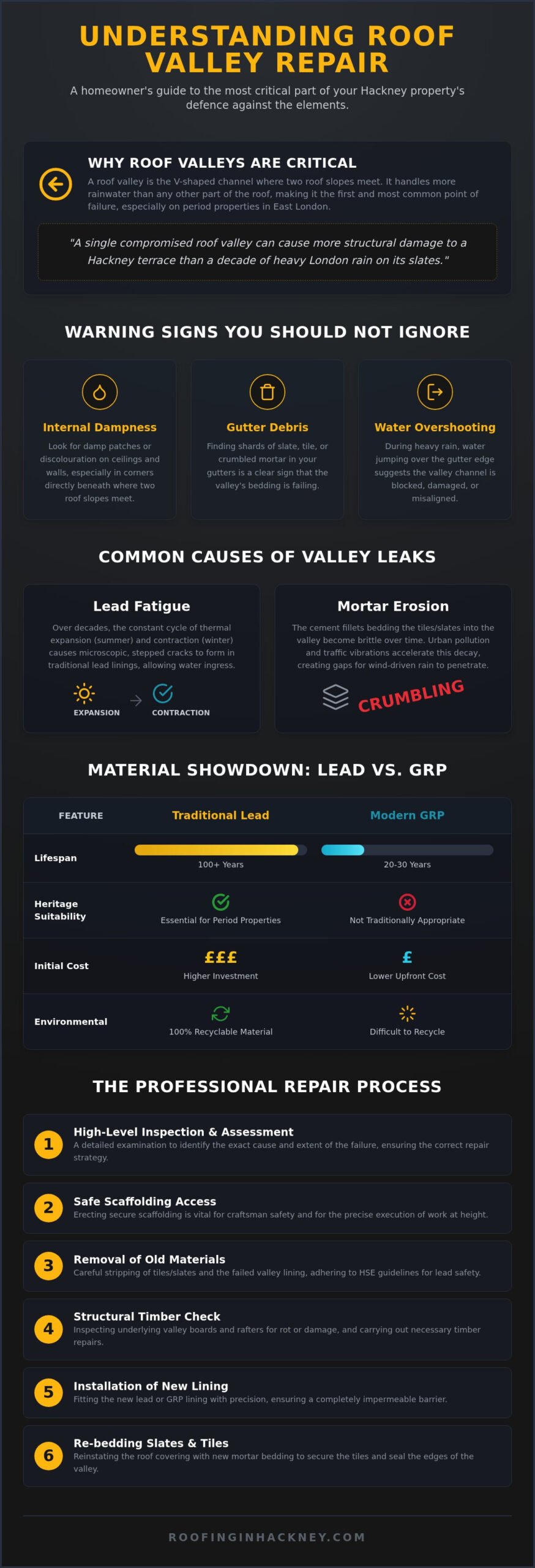
- Internal Dampness: Patches appearing on ceilings or walls directly beneath internal roof corners or where two slopes intersect.
- Gutter Debris: Finding shards of slate or chunks of crumbled mortar in your downpipes often suggests the valley’s bedding is disintegrating.
- Water Overshooting: If water leaps over your gutters during heavy rain, it often indicates the valley is blocked or has lost its correct alignment.
Ignoring these signs often leads to rot in the structural rafters. If you’ve noticed these issues, it’s wise to contact us for a detailed inspection before the damage spreads and necessitates more extensive structural work.
Common Causes of Roof Valley Leaks in Hackney Period Properties
Lead fatigue is the most frequent cause of failure in Hackney’s older properties. Whilst lead is an exceptionally durable material, it’s subject to constant thermal movement. Over decades, the cycle of expansion in the summer sun and contraction in the winter cold leads to “stepped” cracking across the width of the valley. These hairline fractures are often invisible from the street but allow significant water ingress during heavy downpours. When performing a roof valley repair Hackney specialists must also consider the safety implications of working with aged materials. We strictly adhere to HSE guidelines on lead safety to protect both our craftsmen and your home during the removal and replacement process.
Mortar erosion also plays a significant role in drainage failure. Traditional cement fillets, used to bed the slates at the valley edge, eventually become brittle and crumble. In East London, this process is often accelerated by high levels of urban pollution and the constant vibration from nearby traffic. Once the mortar fails, it leaves gaps that invite wind-driven rain to bypass the primary waterproof layer. This is often compounded by debris accumulation. Silt and leaves from urban trees can create “dams” in the valley, forcing water sideways and under the slates.
We frequently encounter poor previous repairs that have actually exacerbated the problem. Many homeowners or general builders attempt quick fixes using bitumen-backed “flashband” or silicone sealants. These materials do not bond permanently with lead or slate and often trap moisture against the underlying timber. This trapped dampness accelerates the decay of the valley boards, turning a simple lining issue into a structural one.
Victorian Terrace Architecture and Valley Stress
Hackney’s architectural landscape is defined by “butterfly” and “parapet” roof designs. These configurations create complex drainage requirements where two slopes converge into a central or hidden valley. These designs are under constant stress from the weight of water and the chemical impact of urban smog. We also frequently encounter “nail sickness” in these properties. This occurs when the iron nails holding adjacent slates rust away, causing the slates to slip and compromise the valley’s watertight seal. Identifying these nuances requires the eye of a Master Craftsman familiar with East London’s heritage buildings.
The Impact of Blocked Valleys on Structural Timbers
A leaking valley is rarely just a surface issue. Standing water saturates the timber valley boards and the underlying rafters. If left unaddressed for even a single season, this moisture invites wet rot or, more dangerously, dry rot, which can spread through the masonry. A simple “patch” often masks these deeper structural failures. If you suspect your drainage is failing, you can request a professional assessment to identify the root cause before structural damage escalates and costs increase.
Lead vs. GRP: Comparing Roof Valley Repair Materials
Choosing the right material for a roof valley repair Hackney project is a decision that impacts your home’s longevity for decades to come. Traditional lead has long been the gold standard for East London’s heritage properties, offering a lifespan that frequently exceeds 50 years when installed by a specialist. In contrast, high-quality GRP (Glass Reinforced Plastic) provides a modern, cost-effective alternative with a life expectancy typically ranging between 20 and 30 years. Whilst GRP is a functional choice for contemporary builds or rear extensions, lead remains the essential material for preserving the aesthetic character and structural integrity of Victorian and Edwardian slate roofs.
Why Leadwork Remains the Specialist’s Choice
Lead’s primary advantage in heritage roofing is its exceptional malleability. Old Hackney terraces are rarely perfectly straight; they settle and shift over time due to their age and the local soil conditions. Lead can accommodate these subtle movements without cracking, unlike more rigid synthetic materials. This flexibility is vital when creating a superior, watertight seal around complex chimney stacks or where a valley gutter meets a parapet wall. To ensure these rigorous standards are met, our team follows the technical benchmarks and best practices established by the Lead Sheet Training Academy. Delivering the kind of expert leadwork Hackney homeowners expect requires a Master Craftsman’s touch, ensuring the material is bossed and dressed into place with precision.
GRP Valleys: When to Consider Modern Synthetics
GRP valleys represent a pragmatic solution for specific architectural scenarios, particularly during flat-roof-to-pitched-roof transitions on modern additions. These pre-formed troughs are lightweight and significantly faster to install than traditional lead, making them a budget-friendly option for non-heritage sections of a building. In certain urban areas, GRP is also favoured because it lacks the scrap value of lead, which effectively eliminates the risk of metal theft. Modern synthetic systems now incorporate advanced UV-resistant coatings to prevent the composite material from becoming brittle under prolonged solar exposure. However, for a period property, the visual contrast between modern plastic and traditional slate can be jarring. We prioritise lead for primary valley gutters to maintain the building’s historical value and ensure the longest possible protection against the unpredictable British weather.
The Professional Roof Valley Repair Process: What to Expect
A successful roof valley repair Hackney project depends on a structured, methodical sequence of technical stages. Rather than offering a temporary patch, a professional restoration addresses every component of the drainage channel to ensure long-term reliability. Our process begins with a non-invasive initial inspection. We often use high-resolution drones or specialised ladders to identify the precise point of water ingress. This approach allows us to assess the damage without walking across fragile slates, which prevents the “collateral damage” often caused by less experienced contractors.
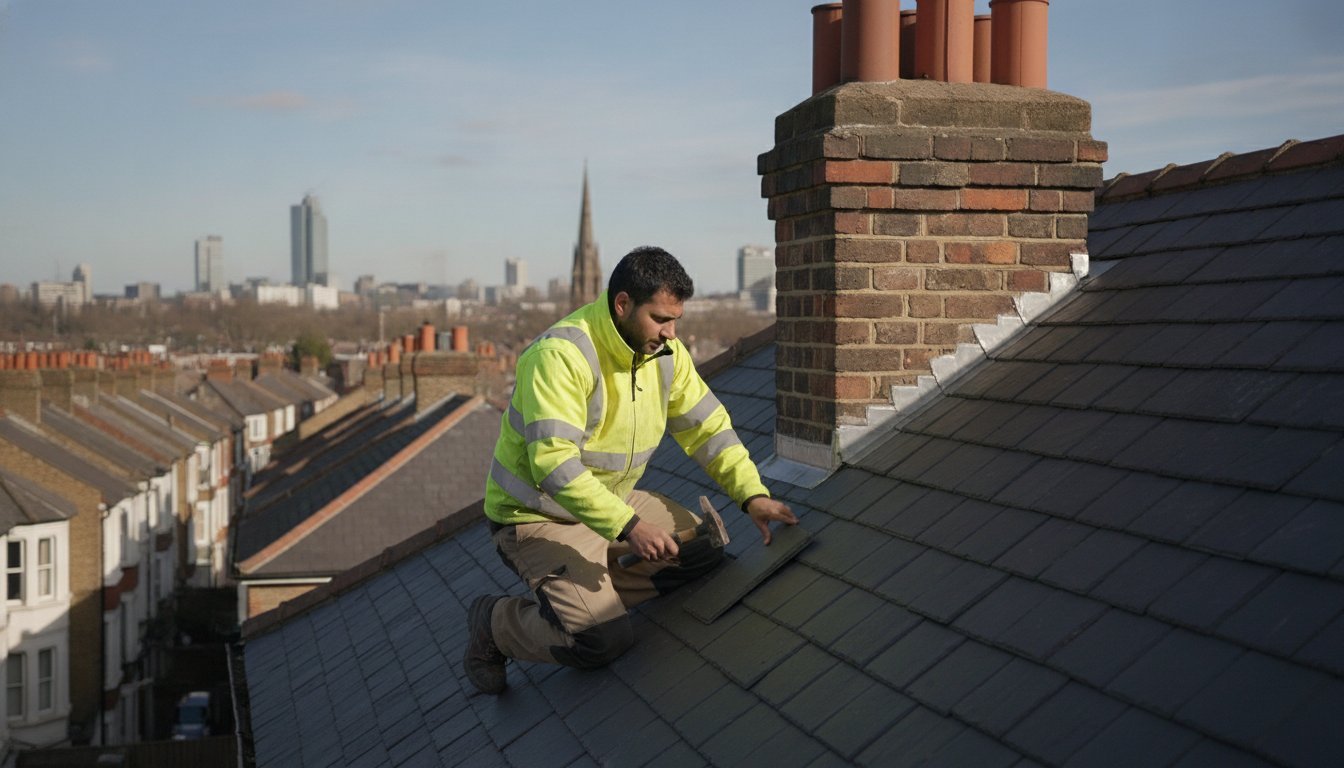
In the dense residential streets of East London, safe access is a primary consideration. Scaffolding is almost always necessary for valley work. It ensures our operatives can work safely whilst protecting your property’s facade and lower roof sections from falling debris. Once the platform is secure, we begin stripping back the surrounding slates or tiles. This carefully exposes the failed lining and the timber valley boards beneath. We perform a rigorous timber assessment at this stage. If the wood shows signs of softening or rot from previous leaks, we replace the boards to provide a perfectly stable base for the new waterproof layer.
Step-by-Step Lead Valley Installation
The core of the repair involves cutting and bossing the lead to fit the unique contours of your roof join. Bossing is a traditional technique where the lead is shaped with hand tools to follow the timber profile without thinning the metal. We apply patination oil to the surface immediately after installation. This prevents the formation of white carbonate staining, which can otherwise wash down and unsightly mark your slates. Finally, we re-instate the slates with a precise overhang. This ensures rainwater is captured and directed into the centre of the lead channel rather than creeping behind the new lining.
Safety and Compliance During Repairs
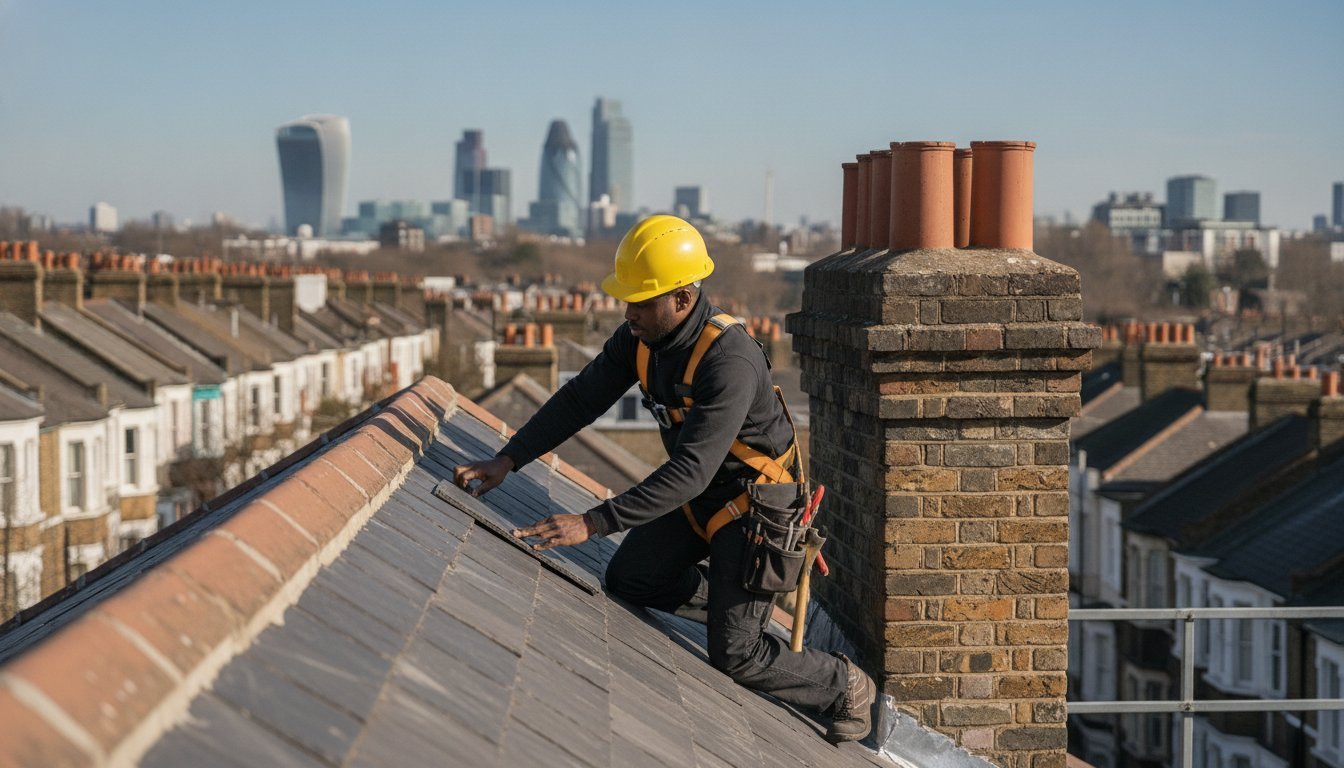
Technical proficiency is matched by our commitment to safety and industry standards. We strictly adhere to Working at Height regulations, which is essential given Hackney’s tall Victorian terraces. All leadwork we install meets current BS EN 12588 standards, ensuring the material thickness is appropriate for the valley’s length and pitch. Before we consider the job complete, we perform a final water-shedding test. This verifies the integrity of the repair under simulated heavy rainfall. If you require a detailed survey of your roof’s drainage, you can book a professional inspection with our Master Craftsmen today to ensure your home remains protected.
Specialist Leadwork and Valley Restoration with Roofing in Hackney
Choosing a specialist for a roof valley repair Hackney project ensures your home’s historic character is preserved whilst its structural integrity is modernised. We approach every restoration as Master Craftsmen, understanding that East London’s architectural heritage requires more than standard building solutions. Our team combines time-honoured leadwork techniques with current building standards to create a finish that is both aesthetically faithful and exceptionally durable. We don’t believe in quick fixes. We believe in doing things the right way. This commitment to quality ensures that your investment provides value for decades, not just seasons.
Organising a major repair in Hackney’s narrow streets and busy residential areas requires meticulous planning. We manage all logistics, from coordinating scaffolding in tight spaces to ensuring our presence causes minimal disruption to your neighbours. We pride ourselves on clear communication and orderly work sites. Our team works with a quiet efficiency that reflects our professional standards. Every specialist leadwork repair we perform is backed by a long-term guarantee, providing you with the calm dependability you expect from a local advisor invested in the community.
Trust the Local Hackney Roofing Experts
Our familiarity with the specific roof types in Hackney and Dalston allows us to diagnose issues that general contractors might miss. We understand the nuances of the butterfly roofs and parapet walls that define our borough’s unique skyline. We always prioritise repair over full replacement whenever the structural integrity allows. This approach saves you unnecessary costs whilst maintaining the original materials of your period home. You can learn more about us and our deep-rooted commitment to local craftsmanship and heritage preservation.
Book Your Roof Valley Inspection Today
Receiving a transparent, no-obligation quote is the first step toward securing your home against water ingress. We provide detailed breakdowns of all required works so you can make an informed decision without any sales pressure. It’s vital to address valley leaks before the winter storm season begins. Heavy rain and freezing cycles quickly turn a minor lead crack into a major structural failure. Contact us today to schedule a specialist assessment of your roof. We’ll help you ensure your property remains watertight and protected against the elements.
Secure Your Hackney Home’s Future Against the Elements
Protecting the structural integrity of a period property in East London requires a proactive approach to drainage maintenance. We’ve explored how identifying early signs of lead fatigue and mortar erosion can prevent escalating timber rot and damage to your home’s internal period features. Whilst modern GRP has its place, traditional leadwork remains the gold standard for achieving a watertight finish that respects the architectural heritage of our local streets.
When you choose our team for your roof valley repair Hackney project, you’re partnering with a fully insured local contractor specialising in Victorian heritage leadwork. Our Master Craftsmen provide expert slate and tile matching to ensure your repair is both technically superior and aesthetically seamless. Don’t wait for a damp patch to become a major structural issue. You can Request a Professional Roof Valley Inspection in Hackney today to receive a transparent, fixed-price assessment from a trusted local advisor. We’re here to help you future-proof your roof and maintain the value of your home for years to come.
Frequently Asked Questions
How much does roof valley repair cost in Hackney?
Costs are determined by the length of the valley, the material selected, and the complexity of access. Scaffolding is a significant factor in East London’s terraced streets. A localised patch might be a minor investment, whilst a full lead relining represents a more substantial structural commitment. We provide fixed-price quotes after a site visit to ensure transparency and avoid the escalating costs often associated with hidden timber rot.
How long does a typical roof valley repair take to complete?
Most repairs are completed within one to three days, depending on the weather and the extent of the damage. A straightforward relining involves stripping slates, replacing the lining, and re-instating the roof covering. If we discover structural issues like rotted valley boards, the process may take slightly longer to ensure the base is secure. We always aim to complete the work efficiently to minimise disruption to your household.
Can I use sealant or “bitumen paint” to fix a leaking roof valley?
We strongly advise against using silicone sealants or bitumen paint for a roof valley repair Hackney project. These materials are temporary “band-aid” solutions that do not bond permanently with lead or slate. They often trap moisture against the timber rafters, which accelerates rot. A professional leadwork repair is the only way to ensure a permanent, watertight seal that respects the structural requirements of a period property.
Will a leaking valley be covered by my home insurance?
Home insurance typically covers sudden and accidental damage, such as a tile displaced during a storm. However, most policies exclude leaks caused by gradual wear and tear, lead fatigue, or lack of maintenance. It is essential to review your specific policy wording. Because valleys are high-traffic drainage points, insurers often expect homeowners to maintain them regularly to prevent predictable water ingress and subsequent internal damage.
Do I need to replace the whole roof if the valley is leaking?
No, a leaking valley does not usually necessitate a full roof replacement. If the surrounding slates and the rest of the roof structure are in good condition, we can focus solely on the valley restoration. However, if the leak has caused widespread rot in the primary rafters or if the slates are suffering from “nail sickness” across the entire pitch, we will provide an honest assessment of your long-term options.
What is the best material for a roof valley on a Victorian house?
Code 4 or Code 5 milled lead is the superior material for Victorian and Edwardian properties. It offers a lifespan of over 50 years and possesses the malleability required to accommodate the natural settlement of older buildings. Whilst GRP is a functional modern alternative, lead remains the industry standard for heritage conservation. It ensures your roof remains watertight whilst preserving the aesthetic harmony of the original East London architecture.
How often should I have my roof valleys inspected?
We recommend a professional roof inspection every two years, preferably before the winter months. Because valleys are the primary channels for rainwater, they are prone to debris accumulation and mortar erosion. Regular checks allow us to clear silt and identify hairline cracks in the leadwork before they develop into serious leaks. This preventative approach is the most cost-effective way to protect your property from expensive structural repairs.
Is lead theft a common problem for roof valleys in East London?
Lead theft is a documented concern in East London, though valleys are less vulnerable than flat roofs as they are partially covered by slates. For homeowners in high-risk areas, we can apply security markings or anti-theft paint. Alternatively, we can install GRP (Glass Reinforced Plastic) valleys during a roof valley repair Hackney project. GRP has no scrap value, making it an effective deterrent whilst still providing reliable waterproof protection.